
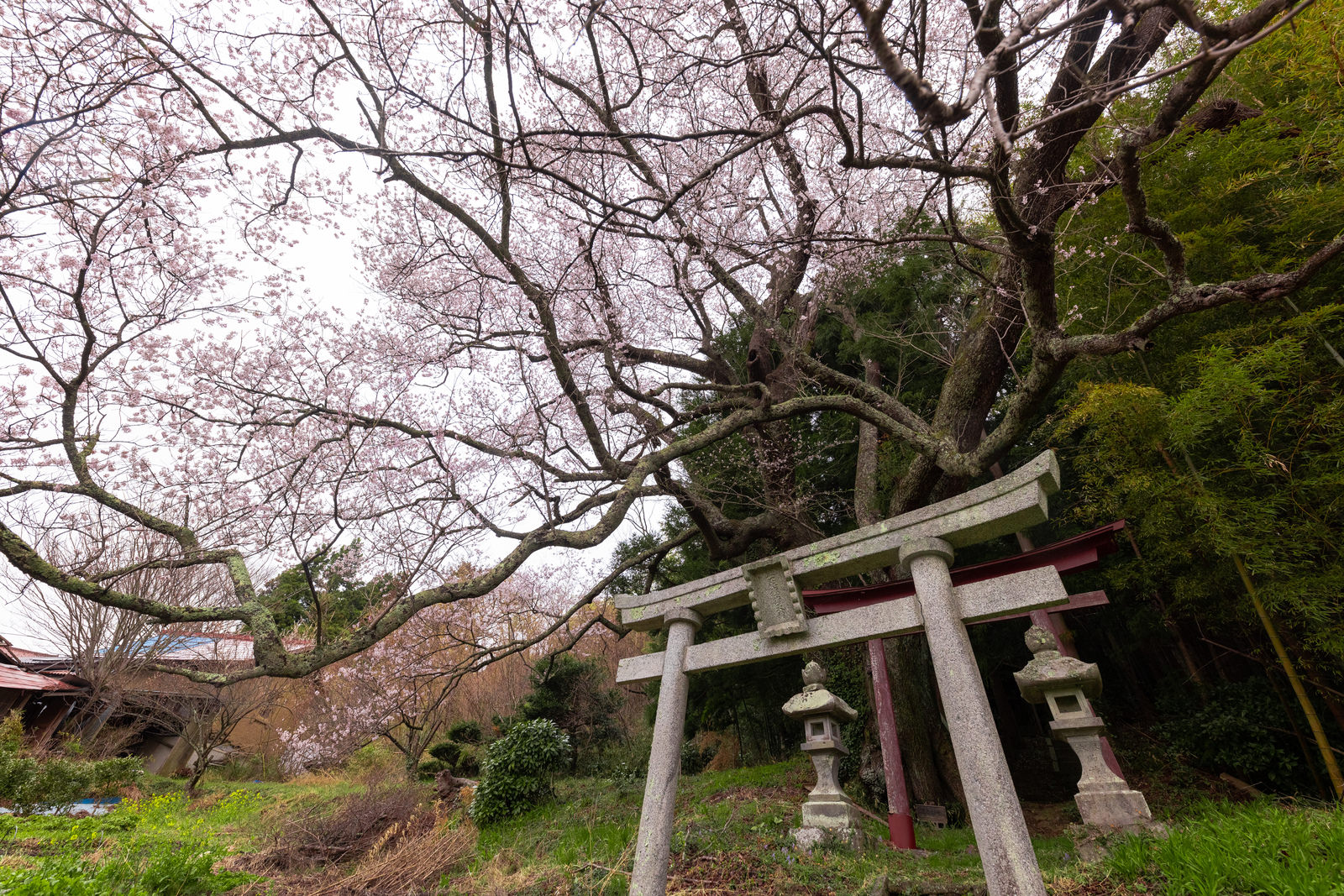
Opening Story: The Hidden Shrine by the Road
It was not a place one would expect to feel peace.
Cars rushed by, their engines growling in steady, mechanical waves.
The smell of gasoline mixed with the faint sweetness of a nearby convenience store’s bakery.
The city around me pulsed — fast, efficient, and utterly unaware of stillness.
And yet, there it was.
Tucked between a row of vending machines and a cracked wall overgrown with ivy, I saw it — a tiny wooden shrine. Barely knee-high, its roof slanted with age, its paint long faded by sun and rain. Someone had placed a single white flower in a chipped glass bottle beside it. A few coins rested quietly on the stone base. The air carried the faint scent of incense, as if a prayer had just finished and lingered, unseen, in the air.
I stopped walking.
For a moment, I didn’t understand why. There was nothing extraordinary about it — no grandeur, no ceremony, no sign explaining who or what was being honored. But something about the way it stood there — humble yet unwavering — pulled me in. The roar of the traffic softened, as though the world had taken a single step back to make room for silence.
I found myself bowing. Not out of obligation, nor from understanding any particular custom — but out of instinct. It was as if my body knew before my mind did that this was not merely a structure of wood and stone, but a pocket of presence.
As I raised my head, I noticed an old man approaching. He wore a faded cap and carried two plastic bags filled with groceries. He paused, bowed briefly to the shrine, and continued on without a word. The act was so small it might have gone unnoticed, but it carried a gravity — a reverence that didn’t demand attention.
And in that simplicity, I felt something shift inside me.
The shrine was not asking for belief. It was simply offering space — space to pause, to remember, to breathe. A fragment of stillness, surviving amid the relentless motion of the city. It reminded me that peace does not arrive with silence alone, but with the permission to be silent.
I stood there longer than I intended. A few more passersby came and went, each glancing toward the shrine with a quiet nod or a brief bow. None lingered, yet none ignored it. The rhythm of acknowledgment itself felt sacred — a wordless conversation between strangers, connected by a single gesture of respect.
When I finally stepped away, the noise of the street returned. But something in me had changed.
The world no longer felt entirely indifferent.
I realized then:
Peace is not found by escaping the noise, but by discovering the small places where it yields —
where something, however tiny, insists on stillness.
That day, in the shadow of vending machines and passing cars, I understood something simple and vast:
“To find peace is not to find a shrine.
It is to recognize that even the smallest shrine —
can hold the world’s gentlest peace.”
The Invisible Shrines of Japan
If one walks through Japan without haste, one begins to notice them.
They are not hidden, yet they rarely call attention to themselves —
tiny wooden altars tucked beneath trees, small stone figures sitting quietly by the roadside,
little torii gates standing beside rice paddies or next to the worn steps of an apartment building.
These are the invisible shrines of Japan — not because they cannot be seen,
but because they exist beneath the threshold of noise and spectacle.
They are places that ask for no recognition, no photograph, no post on social media.
They simply are.
In most cities of the world, sacredness tends to occupy large spaces — cathedrals, mosques, temples that dominate the horizon.
Their grandeur commands awe.
But in Japan, holiness is often measured in the opposite direction: the smaller the space, the greater the quiet.
A shrine the size of a lunch box can hold the same spiritual dignity as a temple that has stood for centuries.
Why?
Because these shrines were never built to separate the divine from the ordinary.
They were built to remind people that the divine already lives within the ordinary.
They sit beside highways, in the corners of rice fields, behind convenience stores —
not as symbols of resistance to modernity, but as companions to it.
They coexist with daily life, whispering: “Even here, even now, something sacred breathes.”
If you ask a Japanese passerby about the shrine near their home,
they might shrug and say, “Oh, that one? It’s just always been there.”
The statement is not indifference; it’s continuity.
It reflects a culture in which reverence has become woven into the background of living —
like the steady hum of cicadas in summer, or the way people bow slightly before crossing a temple gate.
In this way, Japan’s shrines are not just physical structures — they are emotional architectures.
They shape not only how people move through space, but how they move through thought.
They remind the body to slow down for a breath.
They remind the heart that gratitude does not need an audience.
And they remind the mind that peace, once found, is never loud.
A Western traveler might pass one of these shrines and feel puzzled.
“Is this still used?” they might wonder.
The answer is yes — though use here does not mean worship in the conventional sense.
There are no weekly congregations, no sermons, no formal invitations.
Instead, there is the quiet accumulation of gestures:
a bow, a coin, a whisper, a pause.
These small acts, multiplied over time, sustain the spiritual ecology of the land.
In every neighborhood, these gestures form invisible threads,
binding generations of people who never meet but still share reverence for the same corner of earth.
It is a form of continuity that requires no proclamation — a quiet inheritance passed hand to hand, moment to moment.
There is a Japanese word, 依り代 (Yorishiro), which means “a vessel that invites the divine.”
Traditionally, a Yorishiro could be a tree, a stone, or even a human being.
It does not command the gods to appear; it simply offers space for presence to dwell.
Every small shrine in Japan functions as a Yorishiro —
not a house for gods to live in, but a gentle invitation for them to visit.
Perhaps that is what makes these shrines so moving.
They are not monuments demanding attention.
They are invitations, extended quietly to both gods and humans alike:
to stop for a moment, to look, to remember.
And when you do, something changes.
The air feels slightly denser, the light slightly warmer.
The distance between the seen and the unseen softens.
You begin to understand that peace does not descend like a gift;
it emerges, softly, in the spaces we protect from interruption.
In that realization lies a truth that Japan seems to have known for centuries:
Peace does not need to be built — it needs to be noticed.
And the shrines, scattered like whispers through the landscape,
exist precisely to help us remember how to notice again.
The Meaning of Smallness
When you first encounter a tiny shrine in Japan, what strikes you is not its grandeur but its restraint.
It might be no larger than a child’s playhouse — a small wooden structure, sometimes barely taller than the knee,
painted in red or left to weather naturally, with a roof that leans forward like a bow.
No stained glass, no marble columns, no ornate carvings — and yet, the space around it hums with dignity.
At first glance, the architecture seems almost too simple to be intentional.
But this simplicity is not the result of absence; it is the product of exquisite balance.
Every element of the shrine — the slope of the roof, the height of the torii gate, the arrangement of stones beneath —
exists to protect silence, to frame emptiness, to guide the body into awareness.
The Japanese have long understood that when a space stops shouting, the spirit begins to speak.
Unlike Western sacred architecture, which often aspires upward — toward the heavens,
Japanese shrines reach outward — toward the world that already exists.
The divine is not distant, but immanent.
So the architecture does not seek to separate; it seeks to harmonize.
A shrine’s roof extends like the branches of a tree; its wooden columns rest lightly on the earth.
Even the torii gate — the most recognizable symbol of Shinto — is less a barrier than a threshold,
a frame reminding you that stepping through is not a movement of distance, but of awareness.
When one bows before a shrine, one is not approaching a god somewhere else;
one is aligning oneself with what is already here.
That alignment is architectural.
It is felt in the geometry of space, the proportion between stillness and motion, light and shadow.
Every curve and corner of the structure is an act of listening —
to the land, to the seasons, to the subtle rhythm of life that flows unseen beneath modern noise.
If you look closely, you’ll notice that many small shrines are positioned with meticulous sensitivity to their surroundings.
They face east, where the morning sun first touches the roof.
They stand near water, where purity and reflection coexist.
They rest beneath trees that have watched generations rise and fade.
Even the stones leading up to them — uneven, deliberate — slow your steps, forcing you to breathe.
It is design as mindfulness, architecture as meditation.
In this way, the smallness of the shrine is not a limitation but a teaching.
It reminds us that the sacred does not require scale — it requires attention.
A space of reverence does not need to be large enough to contain a crowd;
it only needs to be large enough to contain one sincere moment.
The architecture invites that moment through its humility.
The roof bows, the doorway lowers, the visitor bends — and in that shared gesture of lowering, peace enters.
There is also something profoundly ecological about this architecture.
The shrine is never an intrusion upon the landscape.
It does not cut into mountains or conquer forests.
Instead, it listens.
It borrows the shade of trees, the song of streams, the rhythm of wind.
It adapts to the seasons: moss gathers on its stones, snow folds gently upon its roof,
and rain paints the wood darker with every passing year.
A shrine ages, but never deteriorates — it matures.
In doing so, it mirrors the Japanese understanding that beauty is not in permanence,
but in the graceful acceptance of time’s passage.
Every nail, every plank, every rope carries symbolic resonance.
The shimenawa — the braided rope that marks the sacred boundary — does not seal off;
it signals that the space within is to be entered with care.
The gohei — paper streamers fluttering gently — embody purity through fragility.
They move with the wind, not against it.
The message is unmistakable: true strength is quiet; true sanctity is soft.
A traveler might see such a shrine and think, It’s so small — almost nothing.
But in Japan, “almost nothing” is often the highest form of art.
It is the space that allows everything else to breathe.
The same aesthetic can be found in the ink wash of a sumi-e painting,
where the white space is not emptiness but eternity.
The shrine, too, is a composition of ma — the deliberate pauses between forms.
In that space between materials, between the human and the divine, peace takes shape.
Architect Tadao Ando once said,
“Silence is not the absence of something; it is the presence of everything.”
That is the philosophy every tiny shrine embodies.
Its silence does not exclude — it includes.
It invites not worship but awareness, not submission but participation.
In standing before it, you are reminded that the sacred need not be chased or claimed.
It only needs to be noticed, gently, as one notices the sound of one’s own breath.
Thus, the architecture of Japan’s smallest shrines is not an architecture of walls,
but of thresholds —
spaces designed not to contain peace, but to let it flow through.
The Spiritual Architecture of Quietness
If you linger long enough by a small shrine — the kind hidden at the corner of an alley, or standing quietly beside a rice field —
you will begin to notice the traces of devotion that arrive not with ceremony, but with simplicity.
A mandarin, slightly bruised but placed with care.
A few coins glinting faintly in the sun.
A folded note.
A single flower that someone must have picked on their way home.
None of it looks grand or formal.
There are no priests chanting, no incense thick enough to cloud the air.
And yet, this modest offering speaks with a power that needs no sound.
It is the language of the everyday heart — one that says, “Thank you.”
Or perhaps, “Please watch over me.”
It is not a plea for miracles, but a conversation with life itself.
In Japan, the act of offering (お供え物 Osonae-mono) has never been limited to religious ritual.
It is woven into the fabric of daily existence.
To offer, in this sense, is not to give up something valuable, but to participate in gratitude.
When someone places a piece of fruit before a shrine, they are not losing it — they are acknowledging that it was never fully theirs to begin with.
It came from the earth, and to the earth it will return.
The offering is a gesture of humility, a reminder that ownership is temporary but appreciation can be eternal.
This quiet circulation of giving — the rhythm of receive, appreciate, return —
forms the spiritual ecology of Japan.
It is visible not only at shrines, but at dinner tables, in the simple act of saying itadakimasu before eating.
That one word carries the same sentiment as a rice offering at a countryside altar:
“I am grateful for what life has provided.”
Such phrases are not ornamental; they are the micro-prayers of a culture that finds holiness in ordinary moments.
The offerings themselves change with the seasons.
In spring, pink camellias or freshly picked wild greens might rest on the small altar.
In summer, peaches or cucumbers glisten with dew.
Autumn brings persimmons, chestnuts, or rice stalks, while winter offerings often include sake or mochi —
symbols of nourishment and endurance.
Through these gestures, nature is not simply observed, but conversed with.
Every gift is both temporal and timeless, an acknowledgment that life moves in circles, not lines.
But perhaps what is most moving about these small offerings is their imperfection.
The fruit might be slightly overripe.
The flower might already be wilting.
The coins are not polished, the handwriting on the note uncertain.
And yet, it is precisely this imperfection that makes the gesture human — and therefore divine.
In the same way that wabi-sabi celebrates the beauty of wear and age,
the shrine quietly teaches that sincerity does not need perfection to be pure.
Sometimes, you will see offerings that tell stories if you look closely enough.
A child’s drawing left beside a small statue of Jizō — perhaps for a grandparent who has passed away.
A cup of tea that has gone cold before a local fox shrine — left by someone who wanted to share a drink with the unseen.
A folded paper crane, bleached pale from the sun.
Each offering is an unfinished sentence, written to a presence that listens without reply.
These small rituals, multiplied across countless villages and city corners, form an invisible network of tenderness.
They connect people not through belief, but through mindfulness.
To give something to the gods is to remember that you, too, are part of a greater giving —
the wind gives breath, the rain gives sustenance, the earth gives shelter.
Offering is not an act of transaction but of participation in the ongoing generosity of existence.
In this sense, a shrine is not merely a site of worship; it is a mirror of reciprocity.
The visitor bows, offers, and steps back —
and in that moment, receives something immeasurable in return:
a quietness that feels like safety, a stillness that feels like being seen.
The act of offering reorganizes the heart.
It turns anxiety into attention, and attention into affection.
This is perhaps why even in the heart of Tokyo, amidst the chaos of neon and traffic,
you can find small shrines tucked between office buildings,
where someone has left a can of tea, or a folded piece of origami.
The city hurries, but the shrine waits —
a tiny island of continuity in a sea of interruption.
Every offering left there is a small act of rebellion against forgetfulness.
It says: Even here, in the noise, I can still be grateful.
The Japanese word mimamoru means “to watch over with gentle eyes.”
It captures the relationship between people and their shrines perfectly.
To offer something is to invite that gaze — not of judgment, but of quiet companionship.
The gods of small places do not demand grandeur; they simply ask for presence.
They remind us that to offer attention — to notice, to honor, to pause —
is the greatest offering of all.
And perhaps this is why a foreign traveler, even without understanding the religion or the language,
can stand before such a shrine and feel deeply moved.
Because the essence of offering is universal.
To give thanks.
To remember connection.
To act gently, without asking for reward.
That is the oldest and most sacred form of peace we know.
As the tea cup cools, as the flower droops, as the coin dulls in the sun —
none of these things are wasted.
They are absorbed by the moment itself.
What is left behind is not the object, but the atmosphere of care.
And so, in these tiny shrines scattered through Japan,
we are reminded of a truth that modern life has nearly forgotten:
Peace does not arrive when we receive everything we desire —
it begins the instant we start giving, even the smallest thing,
with the gentlest heart.
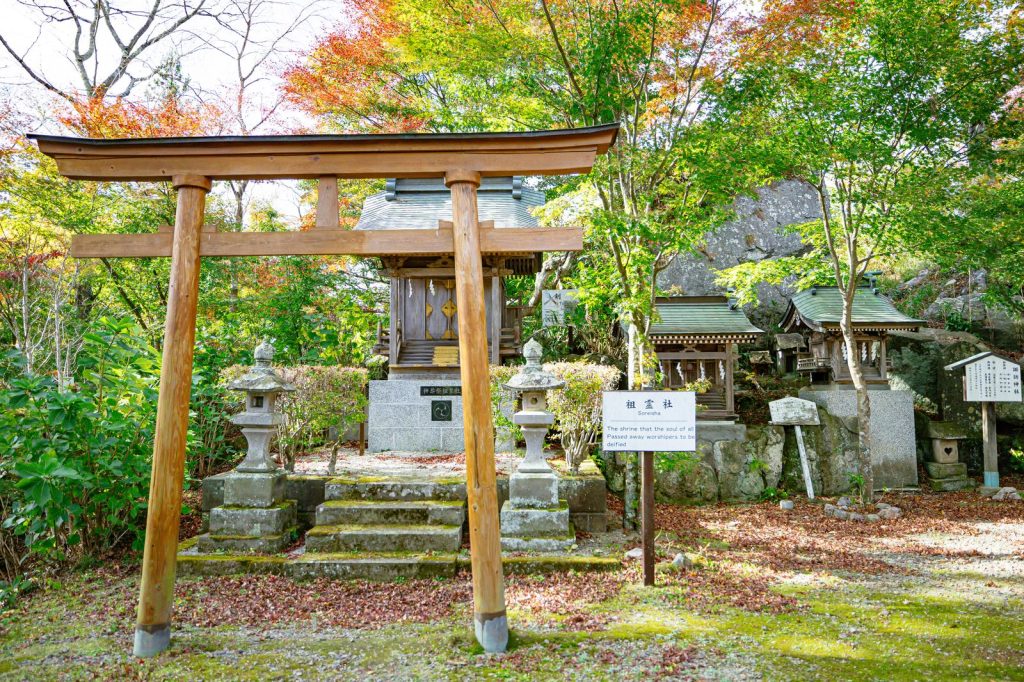
Encounters with the Unseen
Why does standing before a small shrine bring such a profound sense of calm — even to those who do not believe in gods?
Why do we feel safe in quiet, unhurried spaces, when nothing visible protects us there?
The answer lies not in theology, but in psychology.
Stillness, it turns out, is not the absence of life — it is the restoration of coherence.
Our minds are constantly negotiating a flood of stimuli: notifications, demands, words, screens, choices.
Each new interruption fragments our sense of continuity.
We lose the thread of who we are, pulled apart by what the world insists we attend to.
But when we enter a truly still place — a space free from interruption, like a small shrine, a quiet garden, or a room filled with filtered light —
something begins to mend.
Our attention, once splintered, starts to reassemble.
In the hush, we rediscover the feeling of being one person again.
Psychologists sometimes describe this as “cognitive restoration.”
In silence, the brain stops reacting and starts integrating.
In simplicity, attention relaxes from the fight for control and returns to its natural rhythm.
What feels like peace is, in fact, the moment our nervous system realizes it no longer needs to defend itself.
Japan’s shrines and temples intuitively provide this kind of safe stillness.
They are not designed to impress but to absorb.
Stone, moss, shadow, and open space — these materials invite the senses to rest rather than to react.
Where Western architecture often seeks to inspire awe, Japanese sacred spaces seem to whisper:
You can exhale here.
The architecture is not vertical; it does not lift the soul toward heaven.
Instead, it grounds the spirit, asking it to feel the earth beneath its feet.
There is something profoundly human about the way the body reacts in such places.
Your heartbeat slows.
Your breathing deepens.
The chatter in your head — that running commentary of tasks and anxieties — begins to fade.
You become not “a person visiting a shrine,” but simply a presence among presences.
The self stops defending its borders.
It softens, becoming porous enough for the world to enter.
Japanese culture has a long tradition of recognizing this psychological truth without ever naming it in scientific terms.
The concept of “Ma” (間) — the space between sounds, moments, or movements —
is not just aesthetic; it’s emotional.
Ma allows for mental settling.
It gives thoughts room to breathe.
A well-designed shrine, like a well-composed haiku, leaves emptiness not as a void, but as a vessel for awareness.
When someone steps into a shrine courtyard, they often begin to move differently without realizing it.
Their footsteps slow.
Their voice lowers.
Their gestures become deliberate.
It’s as if the atmosphere itself teaches the body to remember its forgotten grace.
This is not obedience to rules — it’s the spontaneous choreography of calm.
In that slow, measured rhythm, the psyche finds safety.
Slowness says, Nothing will attack you here.
There’s a term in environmental psychology — “prospect and refuge.”
Humans feel safest in places where they can observe their surroundings (prospect) but are also protected from intrusion (refuge).
A small shrine, often nestled at the edge of a forest or behind a cluster of houses, perfectly fulfills this balance.
You can see the world, yet remain unseen by it.
This duality — to be within and apart — is deeply soothing.
It mirrors the way we long to live: connected, but not consumed.
In such places, even the air feels different.
You start noticing details you had forgotten to notice — the texture of bark, the sway of leaves, the faint hum of insects.
Your perception expands, but your ego contracts.
And with that shrinking comes relief.
You no longer need to perform existence.
You simply inhabit it.
For many visitors, especially those from faster, more extroverted cultures, this experience can be disorienting at first.
They may interpret the silence as emptiness, the restraint as coldness.
But soon they realize that beneath the apparent stillness lies a warmth that does not clamor for attention.
It is the warmth of acceptance.
Nothing in this space demands to be fixed, improved, or explained.
Everything — including you — is allowed to be exactly as it is.
Japanese people rarely articulate this verbally, but they live it intuitively.
They bow before a shrine not because they fear divine punishment, but because they recognize the sanctity of stillness itself.
The bow is not submission; it is synchronization.
It says, Let me match the rhythm of this peace.
There’s a peculiar paradox about safety: the more we try to control it, the less we feel it.
True safety is not achieved by building stronger walls or louder alarms.
It is achieved when our surroundings tell us, You can stop guarding yourself.
Still places — shrines, gardens, or even quiet rooms — do precisely that.
They deactivate the constant vigilance of the modern mind.
And perhaps this is why, in an age of constant motion, we find ourselves yearning for such small sanctuaries.
We do not need more space, more soundproofing, or more distraction.
We need spaces that allow our souls to reintegrate.
To step into stillness is to step back into the continuity of being human.
When the foreign traveler in our story sits quietly beside the shrine,
he does not “pray” in the traditional sense.
He simply sits — and something within him begins to settle.
He feels as if the world, for once, does not demand anything of him.
And that sensation — that subtle exhale of the spirit — is what he comes to recognize as peace.
To stand in such stillness is not to withdraw from life.
It is to rejoin it at its most elemental level — the level where everything moves in harmony, and nothing interrupts without reason.
In still places, we remember what our nervous systems have always known but our cultures have forgotten:
that quiet is the mother of safety, and safety the soil of joy.
As the traveler leaves, he does not take anything with him.
But he feels lighter — as if the air itself has rearranged the weight of his thoughts.
He carries within him not a souvenir, but a silence that continues to protect him long after he returns to the noise.
And so, the psychology of still places is simple, but profound:
They do not change the world around you.
They change the world within you.
The Peace of Ritual
In a world where grandeur is often mistaken for greatness, Japan has quietly mastered the art of making the sacred small.
A Shinto shrine the size of a child’s toy house can evoke more reverence than a cathedral.
A bamboo grove, no larger than a courtyard, can hold more stillness than a desert.
The Japanese tradition understands that sacredness is not measured by scale or expense, but by the quality of attention it invites.
A tiny shrine, half-hidden beneath the eaves of a rural lane or nestled at the base of a cedar tree, is rarely impressive at first glance.
You could almost miss it.
And yet, once you notice it — truly notice it — the entire landscape begins to shift.
The stones at its base, the soft wear of time on the wood, the faded shimenawa rope…
they all whisper that something is being cared for here.
It’s not the size of the object that creates reverence, but the atmosphere of intention surrounding it.
Japanese aesthetics has a word for this: “Kehai” (気配) — the subtle presence of something unseen yet felt.
A tiny shrine radiates Kehai.
You may not see the divine, but you feel the air organize itself into meaning.
The breeze seems to hush, the light softens, your heartbeat slows.
It’s as if space itself begins to pay attention.
And in that act, you are invited to do the same.
The architecture of small shrines teaches us a profound principle:
that sacredness is not an addition, but a subtraction.
Unlike Western temples, which often build upward — towers, spires, domes —
the Japanese approach is to strip away everything unnecessary until what remains is pure relationship:
between wood and air, sound and silence, presence and emptiness.
This design language begins with humility.
A torii gate is not a wall; it is an opening.
It does not separate the sacred from the profane, but marks the threshold where awareness changes.
Passing through it, one does not enter holiness, but remember it.
The gate whispers: “Look — it was here all along.”
The same restraint governs every element.
The unpainted cedar, allowed to age and silver naturally, honors impermanence.
The roof, often curved and slightly oversized, shelters not only the structure but the silence beneath it.
The stones that line the path are deliberately irregular, requiring you to slow down and place each step mindfully.
Even the offering box — a simple wooden box with slats — encourages sound: the brief clink of coins followed by a pause.
That pause, that breath before bowing, is not incidental; it is the design itself.
To Western eyes accustomed to spectacle, such simplicity can seem austere, even empty.
But within the Japanese worldview, emptiness is the vessel of presence.
A small shrine is not meant to display the divine; it is meant to make room for it.
By clearing away distraction, it prepares the mind to notice.
The sacred is not imported — it appears, gently, when everything else steps aside.
This sensibility is rooted in Shinto’s animism, where gods (Kami) inhabit natural forms — rocks, trees, rivers, wind.
A shrine is not the house of a god, but a sign of recognition:
a way for humans to say, “We see you.”
When a torii stands beside an ancient tree, it does not claim ownership of that place.
It simply marks the relationship — a visual bow between the visible and invisible worlds.
Thus, the architecture of the small sacred is not an assertion of faith; it is an act of courtesy.
The same logic shapes the placement of shrines.
You rarely find them at the center of a village square; instead, they are tucked into corners, near rivers, or beside old roads.
They dwell in the periphery — at the edges where human life meets the vastness of nature.
Their humility allows them to belong everywhere.
You can pass them daily and never feel pressured to stop, yet when you do stop, time itself seems to pause with you.
Inside this humble design lies a subtle psychological truth:
small sacred spaces allow us to approach reverence without intimidation.
Their modesty invites rather than commands.
A grand temple might make you feel small,
but a tiny shrine makes you feel seen.
It says, “You belong in this silence too.”
The design also honors imperfection — the weathered textures of age, the uneven stones, the patina of time.
This is the essence of Wabi-sabi, the acceptance that beauty grows not from perfection but from presence.
A newly built shrine is never truly beautiful until it has endured years of rain and sunlight,
until moss begins to trace its edges, until the wood carries the scent of seasons.
The sacred, in this sense, is a collaboration between human intention and natural time.
In Zen-influenced gardens and tea houses, this principle evolves further.
The environment is shaped not to impress the visitor but to transform the visitor’s state of mind.
Every element — from the path’s curve to the framing of a single view — is designed to guide awareness toward quiet.
When the external world becomes orderly, the internal one follows suit.
A shrine achieves this not by rules, but by resonance.
It does not say, “Be quiet.”
It simply makes quietness inevitable.
We might call this design philosophy “spatial empathy.”
The shrine empathizes with your human need for gentleness.
It gives your senses room to rest.
It listens first, and speaks only when you are ready.
This is why even people unfamiliar with Japanese spirituality often find these spaces profoundly moving.
They recognize, at a visceral level, that the place itself is kind.
There’s also a linguistic clue hidden in Japanese culture: the word “Kami” (神) can mean both “god” and “above.”
But “above” here does not imply hierarchy.
It suggests a lightness, a breath, a subtle elevation of awareness.
The tiny shrine performs that function: it lifts your gaze just enough to remind you that life, too, is sacred —
not somewhere distant, but in the texture of this very moment.
Modern architecture could learn much from this.
In a time when cities are filled with noise and density,
the challenge is not to build higher or brighter, but to design silence —
to create corners of refuge within the vast machinery of living.
A desk by a window, a reading nook, a small garden of pebbles —
these are the new shrines of our age.
Spaces that do not preach, but simply allow the spirit to rest.
As the traveler in our story gazes at the tiny shrine in the village,
he realizes that its peace comes not from mystery, but from measure.
Every detail has been tuned to match the natural rhythm of attention.
It’s a choreography of stillness — wood, stone, shadow, wind, and the human breath — all balanced to a single tempo: slow enough to hear the world again.
He kneels not out of obligation, but out of alignment.
The act feels natural, even necessary.
And in that gentle bow, he senses the purpose of all such places —
not to separate the sacred from the ordinary,
but to remind us that the sacred is already in the ordinary, waiting for us to notice.
As he leaves, the small shrine does not demand remembrance.
It simply remains, as it always has —
quietly holding the balance between visibility and humility, presence and absence, heaven and earth.
And through that delicate balance, it continues to offer what no monument can:
the peace of belonging to something larger than yourself, without needing to name it.
In the end, the Japanese art of designing the small sacred reveals a universal truth:
to make a space holy, one must first make it kind.
For holiness, like peace, does not arrive through command — it arrives through invitation.
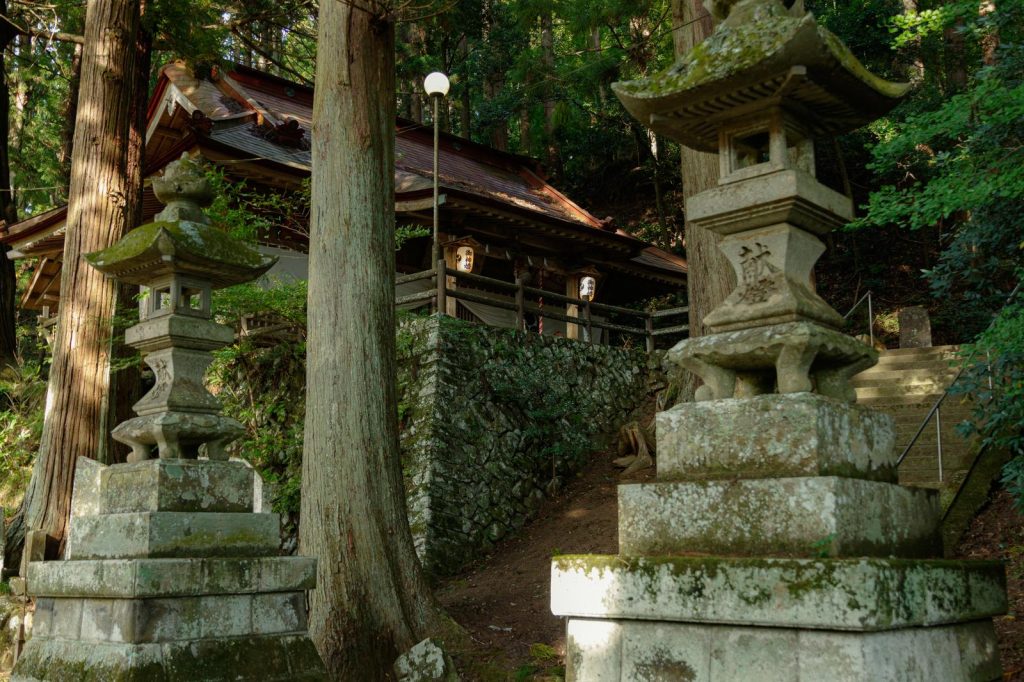
Shrines in the Modern World
At the base of a moss-covered stone shrine, you might find something so small that it seems almost accidental —
a few grains of rice, a mandarin, a cup of sake, a folded paper crane, a wildflower in a chipped glass.
These are not grand gestures.
They are whispers of gratitude, left behind by hands that do not seek attention.
And yet, in their simplicity, they sustain one of the oldest forms of dialogue between human beings and the world around them.
In Japan, offerings are rarely about transaction — they are about continuity.
You do not give to get.
You give to keep the relationship alive.
The tiny shrine does not require gold or grandeur; it asks for presence.
It asks for the act itself — the pause, the bow, the moment of recognition that says,
“Thank you for another sunrise. Thank you for the wind, for water, for breath.”
Each morning, in towns and villages across Japan, people make these quiet gestures.
An old woman places a few grains of rice before her household altar.
A gardener pours tea for the small stone Jizō (Ojizō-san お地蔵さん) by the path.
A shopkeeper lights incense before unlocking the door.
There is no spectacle here, no sermon, no audience.
But these acts weave the invisible threads of care that hold the culture together.
If you ask why, most people will shrug.
“It’s just something we do,” they might say.
But that modest answer conceals something profound —
a worldview in which gratitude is not occasional but habitual,
not performed but lived.
These gestures are not about religion as an institution, but about relationship as a rhythm.
The offering is the heartbeat of that rhythm.
To make an offering is to acknowledge interdependence.
The rice you place on the shrine is a gift returned to the very earth that gave it.
The sake is a distilled form of sunlight, rain, and time — an essence of season and patience.
Even the flowers, cut fresh that morning, remind us that beauty is fleeting and that giving is a form of letting go.
Each offering says: I am part of this cycle. I receive, and therefore I return.
This philosophy reaches deep into the Japanese psyche.
It is visible in the way people bow to the land before planting,
in the way fishermen sprinkle sake into the sea before setting out,
in the way travelers nod to a mountain before beginning a climb.
These gestures are not superstition — they are reciprocity embodied.
To honor what sustains you is to protect the balance that allows you to live.
The beauty of the everyday offering lies in its humility.
There is no hierarchy between giver and receiver, no demand for acknowledgement.
The god of the shrine — the kami — does not need to respond.
Silence is enough.
And that silence, in turn, becomes sacred space.
When you stand before a small shrine and offer something simple — a breath, a thought, a flower —
you are reminded that peace is not achieved through conquest, but through coherence.
In Western religious traditions, offerings often carry the language of sacrifice — something given up for divine favor.
In Japan, the tone is gentler.
An offering is not the loss of something valuable; it is the recognition that nothing was truly yours to begin with.
It is gratitude without possession, generosity without calculation.
Even a child placing a pebble at the base of a Jizō statue understands this instinctively.
It is the act of saying, I see you. I am here with you.
Consider the small wooden trays placed at many roadside shrines.
They are exposed to wind, rain, insects, and time.
The fruit spoils, the flowers wilt — and no one rushes to remove them.
Decay itself is part of the ritual.
In that gentle fading, there is a lesson:
that giving is not about permanence, but participation.
The offering lives only in the moment it is made, and in the heart of the one who leaves it.
Such offerings also sustain a psychological sanctuary.
They remind us that gratitude can be physical, tactile, visible —
a gesture that grounds the spirit in the body.
In an age where thanks are typed into screens and instantly forgotten,
the slow ritual of arranging an offering reconnects us to presence.
It demands care: choosing the right leaf, aligning the cup, bowing lightly.
Each motion becomes a meditation.
Through repetition, these small acts train the heart toward stillness.
In urban Japan, even where space is scarce, the tradition persists.
A tiny altar might sit on a balcony.
A miniature torii could be tucked beside a parking lot.
Some people keep an ofuda — a small sacred paper — in their wallet or by their desk.
Even these micro-shrines carry immense symbolic weight.
They say: “Even here, among concrete and cables, there is room for reverence.”
The city does not erase the sacred; it simply hides it in plain sight.
There’s also a communal dimension to these gestures.
During festivals, neighbors clean the shrine together, replace its offerings, sweep the path.
The act itself becomes a form of collective mindfulness.
You don’t discuss theology; you sweep leaves.
You polish brass. You tie fresh ropes.
Through these actions, people remember that community is not maintained by agreement, but by shared attention.
In this sense, offering is not only vertical — between human and divine — but horizontal,
between neighbors, between generations, between the living and the unseen.
The same hands that leave rice today once received the habit from a grandmother’s example.
Thus, every offering is also a form of inheritance —
not of wealth, but of awareness.
Philosophically, the act mirrors the essence of Wabi-sabi and Mono no aware.
It honors transience and imperfection, and it does so without lament.
To leave a flower knowing it will fade is to practice acceptance.
To make an offering knowing it will vanish is to release attachment.
In that release, we find the quiet peace that no accumulation can provide.
There is a subtle paradox at work:
the more one gives, the lighter one feels.
In giving, one is not diminished — one is restored.
Because what is truly offered is not the object itself, but attention, time, care.
And these, unlike material things, multiply when shared.
A grain of rice offered in awareness becomes a feast in the language of the soul.
One afternoon, the traveler in our story witnesses an elderly woman stop by the tiny shrine beneath a persimmon tree.
She opens her palm and gently scatters rice.
For a brief moment, the grains shimmer in the sunlight before disappearing into the earth.
No one watches. She does not linger. She simply bows and walks on.
The gesture lasts only seconds, yet the stillness that follows stretches wide as eternity.
In that instant, he realizes: the offering was not to the shrine, but to the moment itself.
And perhaps this is the essence of peace —
to give without measure, to thank without reason,
to find sacredness not in grand ceremonies, but in the everyday kindness that renews the world quietly.
As the Japanese saying goes:
「おかげさまで Okagesamade」— “Thanks to the grace around me.”
It is a phrase that carries no direct object, no subject, only relationship.
That is the heart of every offering — a thank you that belongs to everything, and to no one in particular.
In the end, the tiny shrine reminds us that peace is not the absence of need,
but the abundance of gratitude.
And each humble offering, no matter how small, becomes a way of whispering to the universe:
I remember. I am still listening.
Lessons for a Restless World
If you return to a tiny shrine over the course of a year, you begin to notice that time does not simply move there — it layers.
Moss thickens on the roof. The wooden planks darken with rain. The flowers on the altar change with the seasons: plum blossoms in spring, hydrangeas in summer, pampas grass in autumn, pine sprigs in winter.
And yet, the space itself remains constant — a still point around which the entire village, the entire flow of life, turns.
The shrine is not concerned with the ticking of clocks.
It follows a different rhythm — the breathing of nature and the remembering of people.
Each visit, each bow, each offering is a stitch in the long fabric of continuity.
Even when no one is present, even when the road is empty and the rain falls softly, the shrine keeps time — not by counting moments, but by holding them.
In the West, time is often imagined as a straight line: past behind, future ahead.
But in the world of the shrine, time moves in circles.
It turns like the seasons, like the rice cycle, like the dance at a festival that has no beginning or end.
You can never be “late” to a shrine, because the shrine waits.
It has waited for centuries. It knows that humans come and go, but reverence endures.
To kneel before such a place is to step out of linear time.
The present deepens; it does not pass.
You feel the invisible presence of those who once stood here — a grandmother who prayed for her child’s health, a farmer who thanked the rain, a traveler who bowed before moving on.
Their gestures still echo in the air, as faint as incense but as real as memory.
The shrine is a vessel for those echoes, keeping them alive not as ghosts, but as vibrations of care that never fade.
Sometimes you can sense this continuity through the smallest details.
The wood that creaks under your hand has been touched by generations.
The rope, rough with age, carries the oils of countless palms.
Even the stone steps, worn smooth in the middle, record centuries of devotion.
Every object is a witness, every scar a signature of time’s tenderness.
And yet, the shrine does not feel old — it feels alive.
Its age is not decay; it is depth.
Just as the rings of a tree reveal its story, so the weathered textures of a shrine reveal a life lived in harmony with impermanence.
The shrine does not resist change — it absorbs it, dignifies it, transforms it into presence.
That, perhaps, is how the Japanese manage to preserve beauty without freezing it: they allow time to participate in the art.
There is also something profoundly human about how shrines keep time.
They remind us that remembrance is not nostalgia, but continuity of gratitude.
When a family visits the same small shrine year after year, they are not repeating an act — they are renewing a relationship.
The same path, the same bow, the same offerings — each one slightly different, each one carrying the weight of all those before it.
It is as if the shrine itself remembers them, the way a river remembers every ripple.
During New Year’s, people line up to make their first prayer — hatsumōde.
During harvest season, they return again with thanks.
And throughout the year, they might stop by in moments of uncertainty or quiet joy.
These cycles of visitation form a rhythm deeper than any calendar.
The shrine keeps time not by measuring it, but by embodying repetition as renewal.
In this way, the shrine becomes a calendar of feeling, a map of returning.
Each visit, each offering, each breath before the torii gate reminds us:
we are part of a continuum much larger than ourselves.
We do not stand at the center of time — we stand within it, humbly, like a leaf in a current.
To live with this awareness is to live gently, to know that every moment is already shared with those who came before and those who will follow.
And the silence of the shrine — that deep, surrounding quiet — is not emptiness but containment.
It holds generations of whispers.
It listens, endlessly.
It allows both grief and gratitude to coexist without conflict.
Standing there, you realize that this is not a place of asking, but of remembering —
remembering that everything we seek has already been given, many times over, by the rhythm of the earth itself.
If one listens carefully, even the wind through the trees carries the language of time.
It passes over the rice fields, across rooftops, through schoolyards, and eventually finds its way to the shrine.
It is as if the world exhales there, resting for a moment before continuing on its way.
This is how the Japanese landscape breathes — through places that refuse to hurry.
For the traveler, the realization comes slowly:
The shrine is not a relic. It is a continuum.
It gathers fragments of countless human lives and holds them in balance — like pebbles arranged carefully around a sacred spring.
It teaches that peace is not found in what endures forever, but in what endures through renewal.
To return, to repeat, to remember — these are sacred acts.
In an age obsessed with progress, the shrine stands as a gentle protest.
It says, Do not rush. Do not discard. Stay long enough to see time settle.
It reminds us that what we call “the present” is not a thin line between past and future,
but a vast, living field where all moments coexist, waiting to be acknowledged.
And perhaps this is why standing before a tiny shrine can bring such inexplicable calm —
because, for once, we feel aligned with time instead of chasing it.
A philosopher once wrote, “Eternity is not endless time; it is timeless presence.”
That presence lives quietly in every shrine — not monumental, not loud, but enduring.
Even when storms wash away the offerings or fire rebuilds the structure,
the spirit of the place remains untouched.
Because what the shrine truly preserves is not architecture, but attention — the collective act of caring across generations.
So when you next encounter a small shrine by the roadside, pause for a moment.
Look closely. You will see not just a structure, but the memory of time made visible.
You will sense the presence of those who have loved this land enough to stop, to bow, to remember.
And in that awareness, something within you may also slow down, settle, and align with the deeper rhythm of the world.
Because the shrine does not keep time like a clock.
It keeps time like a heart — steady, patient, beating quietly beneath the noise of history.
Closing Reflection: Where the Small Gods Rest
There is a peace in this country that does not announce itself.
It hides in the corners of gardens, beneath eaves, along forgotten roads.
It takes the shape of a small shrine — sometimes no bigger than a cupboard —
and it waits.
It waits not for worshippers, not for attention, but simply for someone to pause.
Because peace, the kind that lasts, is not achieved through conquest or persuasion —
it grows in the pauses we dare to honor.
In a world that moves faster every day, the tiny shrine stands as a kind of rebuke to haste.
It says: Stay still. Listen. Let the silence do the talking.
Its doors do not open with noise but with humility.
Its offerings are modest — a cup of sake, a handful of rice, a paper crane.
Yet within that modesty lies something immense: the reminder that the sacred need not be large to be profound.
I have stood before such shrines in the soft rain of spring, in the heat of midsummer, in the crisp quiet of autumn dusk.
Each time, I felt the same stillness —
not empty, but alive with patience.
It is the stillness of something that knows how to wait.
Not waiting for a miracle, not waiting for praise, but waiting simply to be seen with care.
Perhaps that is what peace truly is — not the absence of conflict, but the presence of attentive waiting.
To wait without expectation, to be quietly available to the world — that is a rare strength.
The shrine embodies it effortlessly.
It is always there, whether anyone notices or not.
Its faithfulness is not measured in visits, but in endurance.
When I think back to all the small shrines I’ve passed —
some standing proudly beneath ancient trees,
others leaning slightly, half-swallowed by weeds —
I realize that what moved me was not their beauty,
but their persistence in gentleness.
They never asked for more than acknowledgment,
never claimed authority, never competed for grandeur.
They simply offered a place where the world could breathe.
And in that simplicity lies their greatness.
Because to offer peace in a noisy world is the most radical generosity.
To remain still while everything rushes past — that is devotion without doctrine.
A shrine teaches us that silence can outlast sound,
that softness can withstand time,
that presence can exist without performance.
The philosopher Bashō once wrote:
“Sitting quietly, doing nothing — spring comes, and the grass grows by itself.”
The shrine lives that poem.
It sits quietly, doing nothing — yet seasons bloom around it.
It participates in life through non-interference.
It teaches by remaining.
As I reflect on this journey — a hundred moments of quiet across Japan —
I realize that every essay, every encounter, every act of noticing
has been leading toward this understanding:
that peace is not something we build; it is something we return to.
It is already here, already waiting, in the still corners of the world.
All it asks of us is to slow down enough to meet it.
When I think of the tiny shrine, its stone steps slick with rain,
its lantern glowing faintly at dusk,
I feel a kind of gratitude that has no object —
a gratitude simply for being allowed to exist within this gentleness.
No one owns this peace.
It belongs to anyone willing to lower their voice.
The great paradox of such places is that they do not try to inspire awe —
and that is precisely why they do.
In their smallness, they restore proportion.
They remind us that we do not have to be large to matter,
that stillness is a form of participation,
and that care, when consistent, becomes sacred.
So the next time you find yourself walking through a narrow path,
and you notice a small red torii gate tucked between trees —
stop.
You don’t need to pray.
You don’t need to understand the rituals.
Just stand there.
Let the silence touch you back.
Let the patience of the place seep into your breathing.
And maybe, for a fleeting moment,
you will sense what countless generations before you have felt —
a quiet alignment between heart, earth, and time.
A peace that asks for nothing, promises nothing, but gives everything.
It is the peace that waits in small places.
The peace that never leaves, even when we forget it.
The peace that has been whispering, all along:
You are already home.
And so, in these last words, the heart of QuietTether comes softly into view.
“Peace does not demand attention.
It waits — in the spaces we neglect,
in the pauses we fear,
in the shrines we almost overlook.”