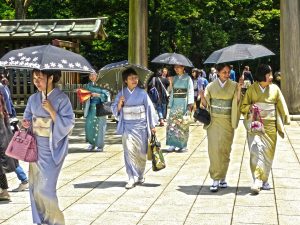

Opening Story: A Lost Umbrella and an Unexpected Gesture
The day had begun with promise. The foreign traveler, having only recently arrived in Tokyo, woke early with plans to explore one of the city’s quieter neighborhoods. He had read about its winding alleys, its understated cafés tucked behind shoji-screen doors, and its sense of old-world Japan still lingering despite the modern skyline. The morning was clear, and the air felt crisp, almost celebratory, as if welcoming him to his adventure.
But Tokyo weather, much like the city itself, can change swiftly. By the time he had wandered into a marketplace brimming with fishmongers, green tea vendors, and steaming trays of street-side snacks, the sky darkened into a heavy, slate gray. Within minutes, rain fell—not a light drizzle, but a sudden, insistent downpour that sent shoppers scrambling for cover.
The traveler instinctively reached for his umbrella, the small collapsible one he had brought from his home country, tucked neatly into the side pocket of his bag. Yet when his hand searched, it touched nothing. He realized, with a sinking feeling, that he had left it leaning against the wall of his guesthouse that morning. Now, in the middle of a crowded market, the rain was unrelenting. His jacket, though water resistant, quickly soaked through, and droplets streamed down his hair, blurring his glasses.
He darted beneath the awning of a noodle stall, pressing himself against the wooden post, trying to make himself small. He was not the only one caught unprepared—several other people had sought refuge under shop fronts. But unlike him, nearly everyone else eventually produced an umbrella from a bag or purse, popped it open with ease, and moved confidently into the curtain of rain.
The traveler stood awkwardly. He told himself it was only water, and perhaps he could endure it, but his destination—a small temple rumored to be hidden near the neighborhood’s edge—was still a fifteen-minute walk. He would arrive drenched, miserable, and cold. He sighed, resigning himself to wait, though he had no idea how long the rain would last.
It was then that something curious happened.
From the crowd moving swiftly through the rain, a figure slowed. A middle-aged Japanese man, dressed in an office suit, his tie slightly loosened, carried a wide black umbrella. His pace faltered as his eyes caught the traveler—this foreigner awkwardly pinned against the post, trying to shrink away from the torrent. The man’s gaze lingered for just a second, then without hesitation, he approached.
The traveler, startled, shifted slightly to give way. He assumed perhaps the man wanted to ask for directions, or perhaps he was also seeking cover beneath the awning. But instead, in one fluid, almost wordless gesture, the man extended the handle of his umbrella.
The traveler blinked, confused. Was he being offered temporary cover until the storm passed? Did the man intend to share it with him to walk a short distance? Before he could form a question, the man pressed the umbrella gently into the traveler’s hand. The foreigner instinctively grasped it, but his lips stumbled on words—“Oh, thank you! Arigatou!”—barely escaping as the man, already turning, raised a hand in a subtle wave. He stepped back into the rain without any cover, his shoulders immediately wet, and continued down the street.
The entire exchange lasted less than ten seconds. No explanation. No conversation. No lingering glance that sought recognition. The umbrella was given, and the giver disappeared.
The traveler stood stunned beneath his new shield, the rain pattering rhythmically above his head. He craned his neck, hoping to spot the man among the crowd, to shout his thanks once more. But the tide of umbrellas had already swallowed him whole. The city moved on, unbothered, unpausing.
As he began walking again, dry now, the traveler felt the weight of the umbrella in his hand—a simple, inexpensive object, yet it seemed imbued with a significance far greater than its utility. The act was so quiet, so self-effacing, that he wondered whether he had truly deserved it. There had been no chance for him to even return the kindness. No opportunity to ask the man’s name, to promise repayment, to exchange the universal handshake of gratitude.
And yet, perhaps that was precisely the point.
This was not kindness meant to be acknowledged. It was not an act intended to earn admiration or praise. It was something else entirely: a gesture invisible in its intention, almost hidden in its design, yet profound in its impact.
The traveler thought back to his own culture. Back home, kindness was often framed in exchanges—offered in visible ways, with words and thanks expected to seal the transaction. Here, he realized, kindness could slip past the spotlight, existing not for recognition but for the simple act of relieving another’s discomfort. It asked for nothing. It did not even wait to be noticed.
By the time he reached the temple, the rain had softened into a mist, and sunlight broke shyly through the clouds. Standing at the temple gate, umbrella still in hand, he found himself repeating the moment in his mind—the quiet offering, the man’s disappearing figure. He had experienced something he would later describe as more powerful than any spoken declaration of generosity.
It was in that instant he understood: sometimes the most meaningful kindness is not the one shouted aloud, but the one slipped gently, invisibly, into the lives of others.
The Cultural Value of Subtle Kindness
When the traveler reflected later on the umbrella incident, what struck him was not simply the generosity of the act but the manner in which it was carried out—quietly, without words, without a lingering expectation of gratitude. It was a kind of kindness that seemed to dissolve as soon as it appeared, almost as if the giver wanted it to be invisible. And yet, precisely because of its invisibility, it carried a peculiar strength.
This phenomenon is not accidental. In Japan, kindness is often woven into the very fabric of daily life in ways that are understated and unannounced. To understand why, one must look deeper into the cultural values that have shaped Japanese society for centuries.
The Subtlety of Everyday Compassion
In many cultures, acts of kindness are tied to visibility. A person donates to a charity and their name is listed on a wall. A volunteer signs up for community service and receives recognition in a newsletter. These acts are genuine, but they also carry with them a measure of social acknowledgment. Kindness, in these contexts, is partly a performance—it is seen, it is praised, it is remembered.
Japan, however, has nurtured a contrasting ideal: kindness should not call attention to itself. If it becomes too obvious, it risks being perceived as 恩着せがましい (Onshisekamashii)—burdening the recipient with a sense of debt. To help someone visibly, while insisting on recognition, is to place weight on their shoulders. Instead, the highest form of generosity is that which dissolves into the air like a faint fragrance: you sense it, you benefit from it, but you cannot grab hold of it.
This ethos is visible everywhere, from daily interactions to grander cultural practices. When a train conductor bows to an empty carriage, when shop staff wrap even the smallest purchase with care, when strangers quietly guide a lost tourist to their destination—these are not acts intended to draw applause. They are simply natural expressions of consideration, folded seamlessly into ordinary life.
Historical and Philosophical Roots
Why has subtlety come to define kindness in Japan? The answer lies in a confluence of historical and philosophical influences.
First, Buddhism, especially the Mahayana tradition, emphasized 無私 (Mushi)—selflessness—as a spiritual virtue. Compassion, or 慈悲 (Jihi), was to be extended universally, but without attachment, without clinging to recognition. A good deed loses its purity if it is done for personal credit. Like a monk sweeping leaves from a temple path, the act is complete when done; it does not need to be announced.
Second, Confucianism, which shaped much of East Asia, instilled a strong sense of harmony and relational obligation. In Japan, Confucian thought merged with local sensibilities to create a culture where social balance was prized above individual assertion. In this framework, kindness is best expressed in ways that preserve equilibrium, avoiding overt gestures that might disrupt the subtle rhythms of human relationships.
Finally, the ethos of 武士道 (Bushidō), the samurai code, prized humility, restraint, and quiet strength. A warrior who boasted of his deeds diminished their value; a true demonstration of character was shown in composure, discipline, and silent loyalty. Though the samurai class is long gone, echoes of this ethic remain in the cultural DNA of Japan.
Together, these traditions created a landscape where kindness became something almost paradoxical: it is strongest when invisible, most enduring when it leaves no trace.
The Social Psychology of Subtle Kindness
From a psychological perspective, the invisibility of kindness serves a crucial role in Japanese society. Because communities historically depended on tight-knit interdependence—neighbors, extended families, village networks—social relationships were fragile. To embarrass someone by being too overt, or to force them into a position of indebtedness, could strain harmony.
Thus, kindness evolved into a practice of careful calibration. The giver aims not only to help but to help in such a way that the recipient can accept it without shame, without feeling the need to repay immediately. A hand extended too directly may feel like a spotlight; a hand extended quietly, almost imperceptibly, allows the recipient to take what they need without losing dignity.
This is why Japanese expressions of kindness are often fleeting: the umbrella passed wordlessly, the stranger who escorts you halfway to your destination but vanishes before you can buy them a coffee in thanks. These acts are not incomplete; they are complete precisely because they leave no residue of obligation.
The Traveler’s Surprise
For the foreign traveler, the umbrella was not only a reprieve from rain—it was an entry point into this philosophy. Back home, he was accustomed to kindness that was wrapped in words. “Here, let me help you.” “Don’t mention it.” “I’m happy to do this for you.” The exchange was not only practical but also verbal, reinforced through a ritual of acknowledgment.
But here, in Tokyo, he encountered kindness stripped bare of words, offered with the quiet certainty that words were unnecessary. It was, to him, almost shocking. How could someone give so freely, then vanish without even waiting for thanks? Was it indifference? No—he sensed it was the opposite. It was a kindness so pure that it did not even want to be noticed.
A Culture of Natural Generosity
When people say Japanese society values politeness, they often imagine elaborate bows or formal phrases. Yet beneath the visible etiquette lies something deeper: a current of generosity that resists spectacle. The highest compliment in Japan is not “you were very kind” but “you were so natural about it that I hardly noticed.”
This is why the traveler’s experience felt so revelatory. He realized that in Japan, kindness is not a performance; it is a quiet habit. And to live within such a society requires a different kind of sensitivity—not to what is declared, but to what is quietly given.
Everyday Examples of Invisible Kindness
If the lost umbrella story revealed the philosophical underpinnings of Japanese kindness, then daily life in Japan provides countless small demonstrations of how such kindness is practiced. These gestures are so subtle, so woven into the texture of ordinary routines, that they often pass unnoticed by both givers and receivers. Yet, when seen through the eyes of an outsider—or when reflected upon carefully—they reveal a remarkable ethic of thoughtfulness.
The Train Seat Gesture
Perhaps the most iconic example is what happens on Japan’s crowded trains. During rush hour, when every seat is occupied and people stand shoulder-to-shoulder, the smallest shift in posture can change the experience of the ride. In such spaces, offering one’s seat is not done with dramatic flourish. Instead, it often unfolds like a quiet choreography.
A passenger notices an elderly person enter. Without words, they rise from their seat—not slowly, not drawing attention, but with a practiced subtlety. The elderly person sits down, often without even making eye contact, and the train continues. Sometimes there is no exchange of words at all, no “thank you,” no “you’re welcome.” The act is complete in silence.
For a foreign traveler, this can feel strange, even cold. In their own country, giving up a seat might involve a verbal offer—“Please, take my seat”—followed by a reciprocal “Thank you.” But in Japan, the absence of verbal exchange does not indicate ingratitude; it indicates that both parties are relieved of the awkward burden of acknowledging debt. The kindness is offered, received, and absorbed into the flow of life, like rain soaking into soil.
The Quiet Return of Lost Items
Another everyday scene: someone drops a scarf, a glove, or a wallet. In many places, the item might be left on the ground, or returned with an emphatic declaration—“Excuse me! You dropped this!” In Japan, however, the act is often wordless.
A passerby notices the dropped item, picks it up, and places it on a nearby railing or a clearly visible spot so that the owner will notice when they retrace their steps. Or, if they manage to catch up, they simply hand it back, perhaps with a slight bow, and continue on their way. There is no expectation of prolonged gratitude. The helper does not linger. The kindness is executed, but it resists ownership; it does not demand acknowledgment.
This practice extends to the formalized system of 遺失物 (Ishitsubutsu)—lost-and-found services. Even small amounts of money found on the street are routinely handed into police boxes. The person returning it does not receive praise; they simply perform the act as if it were the natural order of things. For the foreign traveler, this can feel astonishing: a society where even the smallest lost object is treated with respect, because it belongs to someone else, and to return it quietly is an act of trust in human connection.
Guiding the Lost Traveler
Perhaps no act of invisible kindness is more memorable for foreigners than the way Japanese strangers assist those who are lost. A traveler stands at a street corner, map in hand, brow furrowed. In many countries, passersby might offer directions verbally, perhaps pointing down the street. In Japan, however, the helper often goes further.
They approach quietly, ask softly if assistance is needed, and then, rather than merely explaining, they walk alongside the traveler. Sometimes they guide them several blocks, even to the very doorstep of the destination. Then, without fanfare, they bow lightly and depart before the traveler can even find the right words of thanks.
It is not unusual for the traveler to feel almost overwhelmed: “How can they take so much time for me, a stranger, and then vanish without expecting anything in return?” But for the Japanese, this is not extraordinary; it is simply kindness performed with humility. The act is its own reward.
Invisible Kindness in the Home
It is easy to imagine kindness as something public, but in Japan, the home is also filled with quiet gestures that often go unspoken. A mother prepares a child’s schoolbag with care, slipping in an extra snack for later. A father checks the weather and leaves an umbrella by the door before his daughter leaves for school. A spouse warms the bath before the partner returns home after a long day.
These are not accompanied by declarations of affection. They are not announced as “Look, I did this for you.” Instead, they are folded seamlessly into domestic life. To those raised in the culture, they may even be invisible—simply what family does for each other. But for an outsider, to notice them is to realize that Japanese households are rich with gestures of care that rarely seek recognition.
The Accumulation of Small Acts
What makes these examples powerful is not their individual scale but their accumulation. One umbrella, one train seat, one scarf returned—these are small in isolation. But across a city, across millions of daily interactions, they create an invisible net of trust.
The traveler who first receives such a gesture may feel surprised. But as they remain in Japan, they begin to notice it everywhere: in the way convenience store clerks handle purchases with care, in the way neighbors share seasonal gifts quietly at the door, in the way strangers step aside on narrow streets without verbal exchange. These are not grand gestures; they are micro-kindnesses, so numerous that they become the air people breathe.
To notice them requires sensitivity. To miss them is to believe the culture cold or indifferent. But once seen, they reveal a society where kindness is not an extraordinary event but a continuous, quiet presence.
The Traveler’s Growing Awareness
The umbrella was the traveler’s first revelation, but the second came on a crowded train. He noticed an elderly woman enter. Before he could react, a young man in business attire rose silently, slipping into the crowd as the woman took his place. No words were exchanged. The train rattled on.
At first, the traveler thought, “How strange, not even a thank you.” But then he realized: perhaps the woman had expressed her gratitude through a slight bow, perhaps the man had declined to accept thanks in order to spare her the burden. The kindness existed, complete, in that fleeting, wordless choreography.
By the end of his journey, he found himself attuned to these invisible kindnesses: the cup of tea quietly refilled, the door held open without a glance back, the store clerk who noticed he was foreign but adjusted her speech gently without calling attention to it. He realized that Japan was not a society lacking in warmth—it was one overflowing with warmth, but expressed in a dialect of silence.
The Sensitivity Required to Notice
Invisible kindness, by its very definition, is not designed to announce itself. It passes like a breeze, subtle enough that unless one pays attention, it is gone before it is ever acknowledged. In Japan, where many acts of generosity and thoughtfulness are practiced without words or flourish, the ability to notice becomes not just a matter of politeness but a matter of cultural literacy.
For the foreign traveler, this realization often comes gradually. At first, kindness feels elusive, perhaps even absent. But over time, with repeated encounters, one learns to tune one’s senses—to see what was previously unseen, to feel what was previously unfelt. Sensitivity is not merely about watching closely; it is about cultivating a state of receptivity.
The Ephemeral Nature of Quiet Kindness
The fleetingness of these gestures is central to their beauty. A seat given on a train, a hand quietly steadying a heavy suitcase, a store clerk slipping an extra napkin into a bag without comment—each disappears as quickly as it appears. If one is distracted, absorbed in one’s phone, or wrapped in one’s own thoughts, the kindness may never be registered at all.
This is unlike more visible acts of kindness in other societies, where the gesture is deliberately made noticeable—“I did this for you”—so that both parties can acknowledge it. Japanese kindness often resists this visibility. To notice it requires an attunement similar to noticing the changing quality of light at dusk, or the faint fragrance of flowers carried by the wind.
The Depth of the Word “Kidzuku” (気づく)
In Japanese, the word 気づく (Kidzuku) means “to notice” or “to become aware.” But its nuance runs deeper than the English equivalent. It is composed of two characters: 気 (ki), meaning spirit, atmosphere, or subtle energy; and づく (dzuku), from “tsuku,” meaning to arrive at, to become attached to, or to realize.
To “kidzuku” is not just to see with the eyes, but to sense with the spirit—to attune one’s awareness to what is softly present. In the context of invisible kindness, it means recognizing an unspoken gesture without needing it to be verbalized or emphasized. It means responding with the heart, not only with words.
For foreigners, learning to “kidzuku” is one of the most profound lessons of living in or traveling through Japan. It asks them to move away from the assumption that kindness must always be declared, and instead to sharpen their ability to feel the intention behind actions.
The Danger of Missing It
When invisible kindness goes unnoticed, it does not cause offense. The giver expects nothing in return. Yet something is lost: the quiet connection between people, the momentary recognition of shared humanity.
For instance, when a stranger moves slightly aside on a crowded street to create space, the act may pass as mere coincidence. But if one notices the intention, the act transforms into a moment of mutual care. To miss it is to miss an invitation into the subtle social fabric that holds Japanese society together.
For the traveler, the first days in Japan might feel strangely impersonal, even lonely, because they fail to register the micro-gestures happening all around them. But as their sensitivity grows, the same city streets begin to glow with hidden warmth. What was once invisible becomes visible—not because the gestures changed, but because the traveler’s perception expanded.
Training the Senses: Mindfulness in Daily Encounters
Developing sensitivity requires a shift in attention. It is, in many ways, a practice of mindfulness. To notice invisible kindness, one must slow down enough to recognize the nuance of others’ actions.
Instead of rushing off the train, one observes how people navigate around each other with care. Instead of taking the bag at a shop without thought, one notices how carefully it was packed. Instead of dismissing silence as indifference, one begins to see it as consideration—the choice not to burden another with unnecessary words.
This sensitivity, once cultivated, spills over into other areas of life. The traveler who learns to notice invisible kindness also becomes more aware of the small beauties of the environment: the moss on temple stones, the sound of water in a roadside ditch, the careful arrangement of seasonal vegetables at a market. The same attentiveness that perceives subtle kindness also perceives the richness of life itself.
The Role of Reciprocity
When one notices invisible kindness, the natural response is not necessarily to speak but to mirror. A slight bow, a softened glance, a willingness to step aside in turn—all are ways of reciprocating within the same subtle vocabulary.
In this sense, sensitivity is not only about receiving but about participating. It transforms the traveler from passive observer into active member of a cultural rhythm. They begin to engage in the unspoken dialogue of kindness: to notice, to accept, and to quietly offer in return.
A Traveler’s Lesson in Awareness
The traveler who once lost his umbrella found himself weeks later walking through a crowded station. An elderly man shuffled behind him, and without thinking, the traveler stepped slightly aside, slowing his pace so the man could pass comfortably. There were no words exchanged, no acknowledgment. Yet in that moment, the traveler realized: he had begun to live within the rhythm of invisible kindness.
What had once puzzled him—gestures too quiet to notice—had now become his own instinct. And in learning to notice, he had also learned to give.
Beyond Japan: A Universal Skill
While deeply rooted in Japanese culture, this kind of sensitivity is not limited to Japan. The capacity to notice invisible kindness exists everywhere; what differs is how much a culture emphasizes or values it. In some places, kindness is more demonstrative, designed to be seen. In others, it hides in the margins.
For the traveler, the gift of Japan is the awakening of this faculty. Once acquired, it cannot be unlearned. Returning home, they begin to see small gestures in their own culture—someone holding a door slightly longer, someone adjusting their voice for the comfort of another. These, too, were always there. The difference is that now, they are noticed.
The Spiritual Dimension
In many ways, the sensitivity required to notice invisible kindness is a spiritual practice. It aligns with Zen teachings about awareness, about perceiving what is subtle and fleeting. To notice such kindness is to honor the present moment, to give weight to the ephemeral, to affirm that meaning is not only in what is declared but also in what is softly offered.
Why Kindness is Hidden
To outsiders, Japanese kindness often feels like a puzzle. Why would someone go out of their way to help, only to vanish before receiving thanks? Why would they deliberately downplay their generosity, or even conceal it altogether? In societies where recognition and acknowledgment are valued, this hidden quality can feel perplexing. Yet in Japan, the very invisibility of kindness is not an accident—it is intentional, rooted in centuries of cultural, philosophical, and spiritual values.
The Fear of Being Onerous: Avoiding “Onkisegamasii”
One of the central reasons kindness is hidden lies in a cultural anxiety about burdening others. In Japanese, there is a phrase 恩着せがましい (Onkisegamasii), which describes the unpleasantness of making someone feel indebted. To perform an act of kindness in a way that demands acknowledgment or gratitude is considered poor taste, even selfish.
Thus, many Japanese people take great care to ensure their kindness does not appear as though they are seeking recognition. A seat is given without eye contact. A lost item is returned without explanation. A favor is offered but immediately downplayed with words like “たいしたことではありません (Taishitakotode wa arimasen)” (“It was nothing at all”). By stripping the act of any performance, the giver frees the receiver from the uncomfortable weight of obligation.
Humility as a Cultural Default
Humility is deeply woven into Japanese communication. From the language of Keigo 敬語 (polite speech) to the ritual of bowing, modesty is a default posture. To highlight one’s own good deed would contradict this ethic.
A story is often told of Japanese employees who, when praised for their hard work, respond not with “thank you” but with phrases like “いえいえ、まだまだです (Ie ie madamada desu)” (“No, no, I still have much to learn”). This deflection is not denial but humility. In the same way, a kind act is never self-advertised. The beauty lies in doing good without pointing to it.
The Influence of Buddhism: Compassion Without Attachment
Buddhist philosophy, which has deeply influenced Japanese culture, teaches the virtue of 無私 (Mushi)—selflessness. In Buddhist thought, to act with compassion should not be tied to personal gain, recognition, or even gratitude. The moment one expects thanks, the purity of the act is diminished.
Invisible kindness reflects this principle. It is compassion offered without strings, like a monk placing food into the hands of the hungry and then stepping away. In this way, the act of kindness remains untainted, free of ego.
The Confucian Legacy: Harmony Over Individual Recognition
Confucian values, which emphasize social harmony and duty, also contribute to the hidden nature of Japanese kindness. In a society where the collective is valued above the individual, drawing attention to one’s own virtue risks disrupting the equilibrium.
In Confucian terms, true morality does not require display; it resides in fulfilling one’s role and obligations quietly. To be seen as a “hero” of kindness might elevate one person above others, creating imbalance. Instead, kindness is folded into the background, woven into the daily rhythm of society.
Protecting the Receiver from Burden
Japanese culture is acutely sensitive to the feelings of the other. An overt display of kindness may inadvertently impose a sense of obligation. If someone loudly announces, “I helped you,” the receiver may feel pressured to return the favor or express gratitude in equal measure.
By concealing the act, the giver spares the receiver this discomfort. The kindness is offered as a gift that demands nothing, leaving the receiver free. The traveler who lost his umbrella understood this: the stranger’s silence and swift departure freed him from the awkwardness of owing something in return.
The Aesthetics of Hiddenness
There is also an aesthetic dimension to why kindness is hidden. Japanese culture has long celebrated the beauty of what is subtle, incomplete, or understated. In Wabi-sabi, the imperfect and impermanent carry their own charm. In the tea ceremony, elegance lies not in grandeur but in restraint.
Invisible kindness follows the same aesthetic. It is an art form of modesty, where beauty comes not from the scale of the act but from its subtlety. The very fact that it can be missed is part of its grace. To notice it is to be invited into an intimate awareness of human connection.
Everyday Disguises of Kindness
This cultural principle can be seen in daily behaviors:
- When a colleague helps finish a task but insists, “I was just passing by.”
- When a neighbor shovels the snow in front of your house at dawn so you never see who did it.
- When someone gives up their place in line, pretending they were “waiting for someone else.”
The act is intentionally disguised so that it does not carry the appearance of generosity. What matters is not the visibility but the effect—the lightening of another’s burden.
A Traveler’s Reflection
For the foreign traveler, the invisibility of kindness at first feels frustrating. “Why won’t people let me thank them?” they wonder. But slowly, the realization dawns: the absence of acknowledgment is not neglect but gift. By erasing themselves from the scene, the giver allows the act itself to remain pure.
This shift in perspective is transformative. Gratitude no longer requires words; it becomes a quiet internal recognition, a sensitivity to fleeting gestures. The traveler learns that kindness can be most profound when it asks for nothing in return.
The Paradox of Hidden Kindness
In the end, the paradox is this: kindness is hidden so that it can be more freely given. Its invisibility ensures its universality, untainted by ego, obligation, or imbalance. What looks like modesty is also generosity—of sparing the receiver, of keeping the act light, of preserving harmony.
In Japan, kindness does not need to be visible to be real. In fact, its very hiddenness is what gives it strength.

Comparisons Across Cultures
When we step outside Japan and look across the globe, the ways kindness is practiced and expressed reveal striking contrasts. While every culture values generosity in some form, the manner in which it is carried out—whether hidden, public, celebrated, or understated—differs significantly. By examining these differences, we can better understand not only Japanese “invisible kindness” but also the broader human spectrum of compassion.
Western Traditions: The Visibility of Kindness
In many Western societies, kindness is often performed publicly and reinforced through visible acknowledgment. Consider philanthropy in the United States: large donations are accompanied by naming rights—university buildings, hospital wings, or public parks bear the names of benefactors. Charitable organizations hold fundraising galas where generosity is openly praised, and individual acts of volunteerism are recognized with certificates, awards, or even media coverage.
This visibility is not necessarily vanity. Within Western traditions, public recognition serves multiple purposes:
- Inspiration: When acts of kindness are visible, they encourage others to do the same.
- Accountability: Public charity assures the community that resources are being used for good.
- Celebration of Values: Societies that highlight kindness reinforce it as a virtue worthy of praise.
The phrase “random acts of kindness” is widely circulated in Western discourse. Yet even these “random” gestures are often described, shared on social media, or documented as inspirational stories. Visibility becomes part of their power.
Japanese Contrast: The Preference for Hidden Acts
Against this backdrop, Japanese kindness stands out. A donation is often made anonymously. A favor is done with the pretense that “it was no trouble at all.” A gift may be wrapped so subtly that the emphasis is not on the giver but on the harmony it creates.
Whereas Western kindness often draws strength from visibility, Japanese kindness draws strength from concealment. Its aim is not to inspire an audience or cement reputation but to quietly maintain interpersonal balance. The beauty lies in what is not said, what is not shown.
East Asian Parallels and Divergences
Looking at neighboring cultures such as Korea and China reveals both similarities and distinctions.
- Korea: Like Japan, Korean culture emphasizes modesty and deference in daily life. However, expressions of kindness may carry a stronger sense of familial obligation, rooted in Confucian filial piety. Acts of generosity, especially toward parents or elders, are expected and often visible within family structures.
- China: Chinese culture, shaped by Confucian and Daoist traditions, values reciprocity. Acts of kindness often create enduring networks of guanxi (relationships of mutual obligation). While the kindness itself may not be loudly proclaimed, the expectation of acknowledgment or reciprocal gestures is stronger than in Japan.
Thus, Japan’s preference for invisible kindness without expectation of return stands apart even among its East Asian neighbors.
Middle Eastern and South Asian Perspectives
In Middle Eastern cultures, generosity is often a deeply visible religious and social duty. Within Islamic practice, Zakat (almsgiving) is one of the Five Pillars, and charitable acts are integrated into daily faith. While humility is encouraged, generosity is celebrated openly as a way to honor God and community. Similarly, in South Asian traditions influenced by Hinduism and Sikhism, acts of service (seva) are often performed communally, reinforcing shared values.
Here, kindness is not meant to be hidden; it thrives in collective acknowledgment, strengthening social and religious cohesion.
African Communal Kindness
In many African contexts, kindness is embedded within the philosophy of Ubuntu—“I am because we are.” Acts of generosity are deeply relational, carried out within community networks. Sharing food, assisting neighbors, or caring for orphans are visible affirmations of interconnectedness. To hide kindness would be counterintuitive, because its visibility affirms communal solidarity.
Globalization and the Modern Shift
Interestingly, globalization has begun to blur these distinctions. In Japan, social media platforms like Twitter or Instagram have introduced a new form of “visible kindness,” where people post about helping strangers or receiving unexpected help. At the same time, Western societies are also embracing subtler forms of kindness, celebrating mindfulness and anonymous giving.
Yet cultural roots remain strong. A Japanese commuter may quietly guide a lost tourist without ever expecting acknowledgment online, while an American may share the story on Facebook as a way of “spreading positivity.” Both are genuine acts of kindness, but they manifest differently.
A Traveler’s Learning Across Borders
For the foreign traveler, comparing cultures becomes a mirror. In their homeland, kindness may be celebrated, spoken of, even displayed. In Japan, it arrives wordlessly, then disappears before thanks can be offered. The traveler begins to understand that neither is superior—they are simply different expressions of the same human impulse to care.
The lesson is not to rank but to appreciate. Visibility inspires; invisibility humbles. Together, they form a global mosaic of compassion.
The Universal Thread
Despite these cultural divergences, one truth remains universal: kindness, whether hidden or visible, strengthens human connection. Whether it is a donor’s name etched on a hospital wall or a stranger’s umbrella silently offered on a rainy street, the effect is the same—someone’s burden is lightened, someone feels seen.
The Japanese model teaches us to listen for what is quiet, to notice what is not performed. Western models teach us to celebrate and spread kindness widely. When combined, these lessons broaden our sensitivity: we can learn to both honor kindness in silence and amplify it when needed.
Emotional and Social Impact
Invisible kindness does more than ease an immediate difficulty—it shapes the emotional fabric of relationships and the broader social atmosphere. In Japan, the quiet and understated nature of kindness generates a distinct form of trust, intimacy, and reassurance. Though subtle, its impact can be profound, resonating long after the act itself.
The Comfort of Quiet Reassurance
Imagine sitting on a crowded Tokyo train. You are standing, holding the rail, when an elderly woman discreetly rises from her seat and gestures for you to sit. She does not smile broadly or insist. She simply shifts away, as though her movement was inevitable, almost invisible. At first, you may not even realize that it was meant for you. But once you sit, a wave of comfort washes over you—not just from resting your legs, but from the awareness that someone cared enough to notice.
This is the first emotional impact of invisible kindness: reassurance without demand. Unlike explicit declarations of care that may sometimes feel overwhelming or obligating, the Japanese style of kindness reassures gently. It says, “You are not alone,” without pressing you to respond or repay.
Building Trust Through Subtlety
When kindness is not displayed for recognition, it fosters a unique kind of trust. The receiver understands that the giver’s motivation is genuine, not performative.
For instance, if a stranger walks with you for several blocks to ensure you find your hotel, and then quietly departs without expecting thanks, you are left with an impression of sincerity. The lack of acknowledgment paradoxically deepens the trust: “This person helped me not for themselves, but for me.”
Over time, such moments accumulate. Within families, within friendships, and within neighborhoods, invisible kindness creates an environment where people rely on one another silently. Trust is built not with declarations but with consistent, understated actions.
Human Warmth Amid Urban Anonymity
Large cities often carry a reputation for coldness. Crowds move quickly; faces blur; people seem wrapped in their own concerns. For foreign travelers arriving in Tokyo or Osaka, this initial impression can be overwhelming. Streets are busy, conversations are hushed, and social boundaries appear strict.
Yet it is precisely in this context that invisible kindness shines most brightly. A shopkeeper adds an extra napkin without being asked. A stranger offers to help lift luggage up the station stairs. A passerby quietly shields you from rain by tilting their umbrella closer. These gestures puncture the anonymity of the metropolis, reminding you that human warmth exists even when it is not loudly declared.
The social impact here is significant: invisible kindness prevents urban life from becoming emotionally barren. It infuses the city with an undercurrent of shared care, subtle but sustaining.
Reframing Misinterpretations of “Coldness”
Many travelers initially interpret Japanese restraint as emotional distance. They may think:
- “Why don’t people smile at strangers?”
- “Why is there so little small talk?”
- “Why don’t families or couples say ‘I love you’ openly?”
But as invisible kindness becomes apparent, perceptions shift. The traveler realizes that what first appeared as coldness is, in fact, an alternative form of warmth—one that is quieter, less demonstrative, but deeply considerate.
This reframing is a transformative moment. The visitor begins to notice kindness where previously they saw only silence. They come to understand that what is unseen is not absent—it is merely subtle.
Emotional Memory and Lingering Gratitude
Another profound impact of invisible kindness is its durability in memory. A loud gesture may be appreciated in the moment, but an understated one often lingers longer.
Why? Because it demands attention after the fact. When someone helps you silently and slips away, you reflect on it later: “Who was that person? Why did they help me? How many such acts have I overlooked in daily life?” The delayed recognition embeds itself in the heart as quiet gratitude.
This emotional afterglow extends beyond the immediate act, often inspiring the recipient to notice and practice subtle kindness themselves. Thus, invisible kindness multiplies its effect not through spectacle but through reflection.
Societal Cohesion Without Words
At a social level, invisible kindness weaves cohesion into Japanese society. It is not institutionalized through law or policy but practiced through countless micro-interactions. People give way on escalators, keep noise low on trains, return wallets intact, or guide lost travelers without expectation.
These small acts maintain social harmony—Wa—which is central to Japanese cultural identity. Unlike societies that emphasize rules or overt communication, Japan sustains cohesion through a network of invisible gestures. The impact is subtle but immense: a society where even strangers quietly look out for one another.
The Traveler’s Emotional Transformation
For the foreign traveler, the emotional journey follows a clear trajectory:
- Confusion: At first, Japan feels distant and restrained.
- Discovery: A moment of invisible kindness—an umbrella offered, a seat given—pierces the silence.
- Reflection: The traveler reinterprets past interactions and realizes they were surrounded by unseen care all along.
- Connection: The traveler feels a new closeness to Japanese society, even if unspoken.
This transformation highlights the psychological depth of invisible kindness. It not only helps in the moment but also reshapes perception, building empathy across cultural boundaries.
Invisible Kindness as a Silent Social Glue
Ultimately, invisible kindness functions as a silent glue binding people together. It strengthens trust, softens urban anonymity, reframes cultural misunderstandings, and creates lasting emotional memory. Its power lies precisely in its subtlety: because it does not demand recognition, it resonates all the more deeply when it is finally noticed.
Lessons for Daily Life
Invisible kindness, though rooted deeply in Japanese culture, is not limited to Japan. Anyone, anywhere, can cultivate the sensitivity to notice and the habit to practice small, quiet acts of care. In fact, learning from Japan’s understated approach to kindness can enrich our own daily lives—whether with family, friends, colleagues, or strangers.
Practicing Subtle Kindness in the Everyday
The first lesson is simple: kindness need not be grand. Instead of waiting for rare opportunities to make a big gesture, focus on small, unnoticed moments:
- Refill someone’s water glass before they ask.
- Pick up litter from the street without making a show of it.
- Hold open a door in a way that feels natural, not performative.
- Leave the last piece of food for another person without drawing attention.
These are not heroic deeds, but their very subtlety is what makes them powerful. They express thoughtfulness without creating obligation, echoing the Japanese principle of Enryo 遠慮 (restraint) and Omoiyari 思いやり (consideration).
Caring for Family Quietly
Within families, invisible kindness can transform daily routines into quiet expressions of love. For example:
- Preparing a lunchbox with a favorite snack.
- Folding laundry neatly before anyone notices.
- Turning on a light for someone coming home late.
- Leaving a note of encouragement tucked discreetly into a bag.
These gestures may not be acknowledged openly, but they are felt. They remind family members that love exists not only in words but in the fabric of everyday life.
Thoughtfulness Among Friends and Colleagues
Friendship and workplace relationships also thrive on invisible kindness.
- Offering help with a task before being asked.
- Listening attentively without interrupting or rushing to speak.
- Noticing when someone is uncomfortable and adjusting the situation subtly (e.g., changing the subject, shifting the environment).
- Sharing useful information quietly—sending a message that says, “I thought this might help you.”
These understated acts build trust and loyalty, showing others that you are attentive and considerate without seeking recognition.
Cultivating Sensitivity to Notice
Invisible kindness requires not only giving but also noticing. Many gestures are lost because the receiver is too hurried or distracted. To develop sensitivity, we must slow down and pay attention:
- Look at the small ways people support you—someone saving you a seat, sharing their umbrella, or checking in with a simple message.
- Train yourself to say inwardly, “I see this kindness,” even if you do not voice it aloud.
- Keep a journal of small acts of kindness you notice each day, to sharpen awareness.
By recognizing these moments, you enrich your own sense of gratitude and deepen connections with those around you.
Gratitude Without Burden
One of the key lessons from Japan is that kindness need not demand a response. Similarly, gratitude does not always require dramatic display.
- A quiet smile.
- A soft nod.
- An internal moment of thankfulness.
These can be enough. Gratitude, like kindness, can be invisible yet deeply meaningful. It maintains balance—appreciation is expressed without placing the giver in the spotlight.
Shifting Focus from Words to Presence
In cultures where “I love you” or “thank you” are frequent, practicing invisible kindness offers a balance. It encourages us to show care through presence and action rather than relying only on verbal affirmation. For example:
- Instead of saying, “I’m here for you,” simply sit beside a friend during a hard time.
- Instead of praising someone loudly, support them quietly in the background.
- Instead of announcing a favor, let the act speak for itself.
Such presence often communicates more than words can, creating a depth of intimacy that transcends language.
Extending Invisible Kindness to Strangers
Perhaps the most liberating practice is extending kindness to those you may never see again:
- Offer directions to a lost traveler.
- Pay for an extra coffee and leave it for the next customer.
- Help someone with heavy luggage at the station.
- Step aside to make room for another person without needing acknowledgment.
These gestures, given without expectation, embody the purest form of invisible kindness. The act vanishes, but its warmth remains in the memory of the one who received it.
Closing Reflection: The Quiet Power of Invisible Kindness
When we think of kindness, many imagine a radiant gesture: a public gift, a heartfelt speech, an act so visible that its impact cannot be ignored. Yet Japan teaches us that kindness, like water seeping into the roots of a tree, does not always need to be seen to nourish life.
The traveler who received an umbrella from a stranger, the commuter who quietly found a seat offered without words, the lost soul guided gently through winding streets—all discover that love and care are not confined to dramatic expression. Instead, they live in moments so small they almost vanish, like raindrops absorbed into earth.
To notice invisible kindness is to cultivate a different vision: one that values subtlety, restraint, and presence. It requires slowing down, opening the senses, and trusting that not everything meaningful must be announced. In silence, gestures gain weight; in humility, they find their beauty.
This way of kindness builds a quiet trust. It whispers, “You are not alone,” without demanding reply. It shows that we are connected not only by shared words, but by shared attention—an unnoticed umbrella, a gentle pause, a hand extended just long enough to steady another.
And so, the lesson is both simple and profound: invisible kindness is not weakness, nor is it absence. It is strength expressed without fanfare, affection given without condition, humanity preserved without proclamation.
QuietTether’s closing philosophy:
“Invisible kindness is not meant to be noticed, yet when we do notice it, we realize how deeply it sustains our sense of connection and humanity.”