
Opening Story: A Cracked Teacup in Kyoto
It was a rainy afternoon in Kyoto, the kind of day when the mist seems to linger over the tiled rooftops like a curtain, softening every edge of the city. A foreign traveler, weary from walking through narrow alleyways lined with wooden machiya townhouses, finally stepped into a traditional tea house tucked away behind a quiet garden. The air was cool, carrying the scent of tatami mats, and the dim light filtering through shoji screens painted the room in gentle shades of ivory and grey.
Invited to sit in silence, the traveler folded their legs and waited. A host, dressed in a subdued kimono, moved with graceful precision, preparing the tools for the tea ceremony. Every gesture—placing the ladle, wiping the bowl, whisking the powdered tea—seemed deliberate, practiced, and deeply reverent. It was a ritual that left little room for distraction.
When the bowl of matcha was finally presented, the traveler took it with both hands, just as instructed. But then something unexpected caught their eye. The tea bowl was not flawless. Across its surface ran several golden veins, glimmering faintly in the light. A crack, once threatening to render the bowl useless, had been filled and mended—not hidden, but celebrated. The repair was not a mark of shame. It was the very feature that gave the bowl its quiet beauty.
The traveler hesitated. In their culture, a broken object was usually discarded, replaced by something new, something unblemished. A crack was evidence of damage, of failure, of imperfection. Yet here, the crack had been transformed into art.
Sensing the traveler’s curiosity, the host smiled gently and spoke:
“This bowl has lived. Its scars are not flaws, but history. The gold is not decoration—it is a reminder that brokenness can be made whole in a way that is even more beautiful than before.”
The words sank deep. The traveler held the bowl closer, feeling the warmth of the tea seep into their hands, but also the warmth of an idea they had never encountered so clearly before. Imperfection was not something to be ashamed of. It could be cherished.
In that quiet tea room in Kyoto, the traveler discovered a new way of seeing the world: a way that did not chase perfection, but embraced the incomplete, the fragile, and the flawed as something profoundly human.
The Philosophy of Wabi-Sabi
To understand why a cracked teacup could inspire such reverence in Japan, one must step into the world of わび・さび Wabi-sabi, a philosophy that has quietly shaped Japanese aesthetics for centuries. Wabi-sabi is notoriously difficult to translate into English, because it is not simply a design style, nor just an artistic movement—it is a way of seeing, a way of being, a lens through which life itself is interpreted.
At its core, wabi-sabi is the appreciation of impermanence, imperfection, and incompleteness. Where many cultures seek symmetry, polish, and permanence, wabi-sabi teaches that true beauty lies in the opposite. It suggests that the weathered wooden beam, worn smooth by countless hands; the uneven glaze of a handmade bowl; the quiet garden where moss grows freely among the stones—these are not deficiencies. They are signs of authenticity, reminders that life itself is fleeting and that nothing endures in an unchanging state.
Wabi and Sabi: Two Sides of the Philosophy
The phrase “wabi-sabi” actually combines two older Japanese words. Wabi originally referred to the loneliness of living in nature, away from society, but over time it came to mean a kind of quiet, humble beauty—an elegance found in simplicity and restraint. Sabi referred to the natural patina of age, the way time leaves its marks on objects and landscapes. Together, wabi-sabi embraces both the deliberate simplicity of design and the uncontrollable passage of time.
A cracked bowl, a fading scroll, or a weathered garden gate are not seen as damaged or neglected. Instead, they are understood as being closer to truth: closer to the reality that all things change, and in that change, they gain depth.
A Counterpoint to Perfectionism
For many visitors from the West, the encounter with Wabi-sabi can be disorienting. Western culture often places high value on perfection: symmetry in architecture, flawless skin in beauty standards, polished surfaces that suggest wealth and control. “Perfect” is equated with “valuable.” Anything chipped, faded, or worn is often thrown away and replaced.
Wabi-sabi offers a counterpoint. Instead of chasing perfection, it asks us to notice the dignity in the unfinished, the charm in the asymmetrical, the honesty in the transient. A garden stone that is slightly askew, a vase with an uneven rim, or the irregular hand-drawn line of calligraphy—these are not errors. They are life itself, refusing to be constrained by rigid ideals.
Beauty in the Ephemeral
Central to wabi-sabi is the recognition of Mujo, the Buddhist idea of impermanence. Everything we see, touch, and love will eventually fade, break, or transform. Far from being depressing, this awareness can make beauty more vivid. Cherry blossoms, for example, are beloved in Japan not despite their short blooming season but because of it. Their fragility is what makes them precious.
In this way, wabi-sabi invites us to accept impermanence not with fear, but with reverence. It tells us that the beauty of a moment lies in the fact that it will not last forever. Just as the cracked teacup in Kyoto was not beautiful in spite of its break but because of it, so too does wabi-sabi suggest that life’s scars—whether on objects, nature, or ourselves—can be embraced as part of our story.
Kintsugi and the Art of Repair
When the foreign traveler in Kyoto first noticed the golden veins running through the cracks of the teacup, what they saw was not simply a repaired vessel but a philosophy embodied in clay and lacquer. This practice is called 金継ぎ Kintsugi—literally “gold joinery.” At first glance, it seems counterintuitive: instead of hiding the break, kintsugi makes it visible, even celebrated, by filling the cracks with powdered gold, silver, or platinum mixed into lacquer.
The result is that the broken object does not return to its previous “perfect” state. Instead, it becomes something new—stronger, more valuable, and more unique than before. The fracture is not erased but illuminated.
A History Rooted in Everyday Life
Kintsugi is said to have originated in the 15th century, when a Japanese shogun sent a broken Chinese tea bowl back to China for repair. It was returned with ugly metal staples. Dissatisfied, Japanese artisans devised a method of repairing broken pottery in a way that would make the damage beautiful rather than shameful. Over time, this technique evolved into a respected art form, inseparable from the spirit of the tea ceremony and wabi-sabi aesthetics.
What began as a practical response to breakage became a philosophy: that damage, instead of diminishing value, could actually enhance it.
A Different Way of Seeing Scars
In many cultures, broken objects are discarded. A chipped mug is thrown away, a cracked plate replaced. But in the Japanese view shaped by kintsugi, the damage is not a sign of failure; it is a sign of life. The crack is evidence that the object has been used, cherished, and tested by time. Just as wrinkles on a human face are not defects but marks of a life fully lived, the golden lines in a bowl are proof of its journey.
This perspective resonates deeply with human experience. Everyone carries invisible scars—losses, mistakes, heartbreaks, failures. Kintsugi offers a metaphor: we need not hide these cracks. They can be acknowledged, embraced, and even transformed into sources of strength and beauty.
Repair as Transformation
What makes kintsugi especially profound is that it does not aim to restore an object to its original condition. Western repair often tries to erase damage, to make the broken part invisible so that the object looks “good as new.” Kintsugi, by contrast, transforms the object into something “good as broken.” It accepts the break as part of the object’s identity and, through repair, allows it to become something it could never have been otherwise.
This is why many collectors and tea practitioners come to value a kintsugi-repaired vessel more than one that has never broken. Its beauty comes not from being untouched but from having endured, been repaired, and now carrying its history proudly.
A Living Metaphor for Human Resilience
In modern times, kintsugi has become a global symbol of resilience. Therapists, writers, and spiritual teachers often draw on its imagery to describe the process of healing after trauma. To be human is to break, in small or large ways. But those breaks need not define us as ruined. Instead, like the bowl veined with gold, our lives can become richer and more meaningful precisely because of what we have endured and repaired.
Kintsugi thus moves beyond craftsmanship into the realm of philosophy. It asks: What if we saw our scars not as flaws to conceal, but as features to illuminate? What if our brokenness was the very source of our beauty?
Imperfection in Japanese Aesthetics
Kintsugi is not an isolated craft. It emerges from a much wider aesthetic sensibility in Japan—one that embraces irregularity, asymmetry, and impermanence as central to beauty. This sensibility is known as Wabi-sabi, but it also finds expression in countless practices: the tea ceremony, pottery, gardens, poetry, and even everyday objects. To understand Japanese culture is to recognize how imperfection is not merely tolerated but celebrated.
The Spirit of Tea: Finding Beauty in the Humble
The Japanese tea ceremony, or Sado (Chanoyu), is perhaps the purest expression of this sensibility. A tea gathering is not about dazzling the guest with flawless china or ornate surroundings. Instead, the utensils are often rustic, the bowls hand-formed with irregular rims, the surfaces glazed unevenly, bearing drips and subtle distortions.
These imperfections are not signs of poor craftsmanship. They are intentional reminders that beauty lies not in symmetry but in individuality. A tea bowl is valued because no two are exactly alike; its uneven surface invites the hand to linger, its rough texture makes the warmth of the tea more tangible.
In this context, a “perfectly round, factory-produced cup” feels lifeless compared to the soulful irregularities of a handmade bowl. What in another culture might be dismissed as defective is, in Japan, cherished as a mark of authenticity.
Asymmetry in Gardens and Architecture
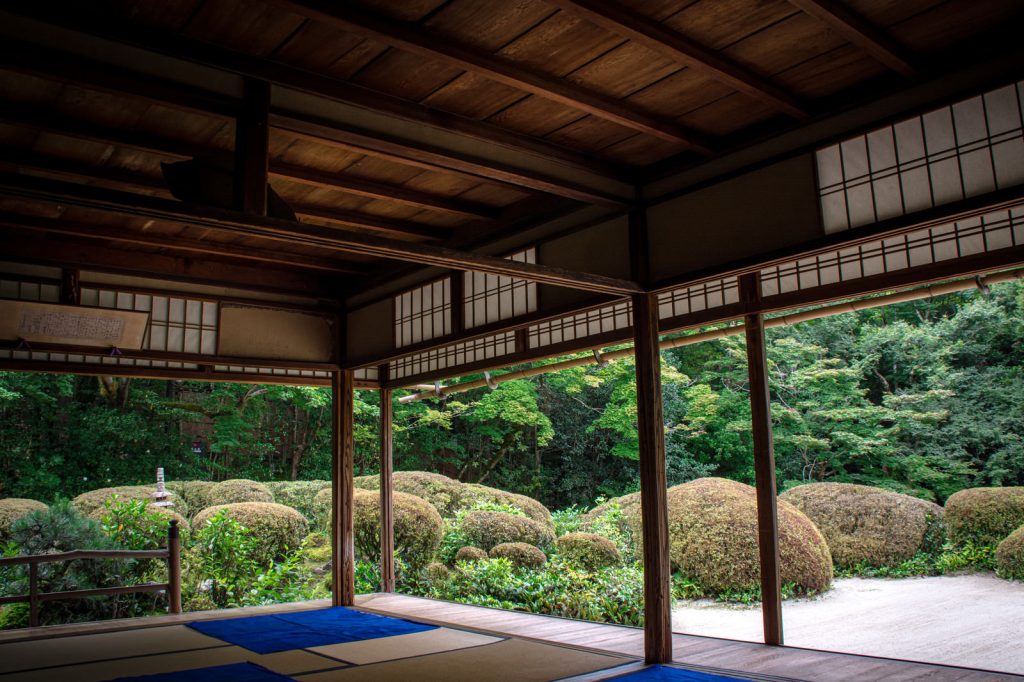
The same principle can be seen in Japanese gardens. Unlike formal European gardens, which often emphasize strict symmetry and control, Japanese gardens revel in natural irregularity. Stones are placed not in neat rows but at seemingly random intervals, carefully chosen to suggest the natural disorder of a mountain stream. Paths curve unpredictably, encouraging visitors to slow down and notice each new perspective.
This preference for irregularity even appears in architecture. Old wooden beams, sometimes warped or slightly uneven, are used deliberately in tea huts to evoke a feeling of humility and organic harmony. The point is not to dominate nature with perfect design but to coexist with it, leaving space for chance, weathering, and age.
The Value of the Incomplete
A striking feature of Japanese aesthetics is the acceptance—even appreciation—of incompleteness. A scroll hung in the tea room may feature a short poem that leaves much unsaid, inviting the guest to fill in the silence with imagination. A rock garden like the famous 龍安寺 Ryōan-ji in Kyoto shows fifteen stones arranged in such a way that, from any angle, only fourteen are visible. The garden is never “complete,” and that very incompleteness becomes its mystery.
This is not failure. It is a deliberate strategy to remind us that wholeness is not about perfection but about leaving room for imagination, interpretation, and growth.
Imperfection as a Mirror of Nature
At its core, Japanese aesthetics sees beauty as inseparable from nature. Nature is never flawless: flowers bloom unevenly, trees grow with bends and twists, stones weather and crack. Rather than smoothing these irregularities away, Japanese culture highlights them. A vase may hold a single wildflower, slightly drooping, its impermanence evoking a moment that will never return.
In this sense, imperfection is not a defect but a truth. To deny imperfection would be to deny the essence of nature itself. By welcoming it, Japanese aesthetics cultivates a deep intimacy with the living world.
A Different Kind of Perfection
This approach creates a paradox. By embracing imperfection, Japanese aesthetics arrives at a different kind of perfection—one rooted not in flawless symmetry but in harmony with reality. The cracked, the incomplete, the irregular become more than acceptable; they become indispensable to the beauty of life.
As the traveler in Kyoto realized when holding the golden-lined teacup, imperfection is not the absence of beauty but the pathway into it.
Imperfection in Daily Life
While the philosophy of imperfection is often highlighted in tea rooms, gardens, or works of art, it is not limited to rarefied cultural practices. In Japan, the acceptance—and even love—of imperfection quietly permeates the rhythms of daily life. From the way flowers are appreciated to the way relationships are nurtured, ordinary people embody this sensibility without necessarily naming it.
The Fleeting Beauty of Flowers
In spring, millions gather beneath cherry blossom trees to celebrate 花見 Hanami—the viewing of blossoms. But unlike in many other countries, the focus is not on the full bloom alone. In fact, Japanese poetry often praises the moment just before the blossoms open or as they begin to fall.
To love a flower in Japan is to love it in its imperfection, when its petals are scattered by the wind, when its colors are fading, when its life is visibly fragile. The flower is most beautiful not because it lasts but because it does not. This sensibility acknowledges that imperfection is simply another word for reality.
The same applies to seasonal flowers placed in the alcove of a tea room. Rather than arranging a lavish bouquet, a host may choose a single branch, its leaves slightly uneven, perhaps already wilting. That “flaw” is what makes it real, and therefore, moving.
Imperfection in Relationships
Daily life is also filled with the imperfections of human interaction. Friends may forget to reply promptly, family members may have misunderstandings, colleagues may stumble in communication. In many cultures, such flaws are seen as failures to be corrected.
But in Japan, there is often a tolerance—sometimes even a quiet acceptance—of these imperfections. A relationship does not collapse because of a crack; it becomes deeper precisely because both sides recognize that imperfection is part of being human.
This is not to say that conflict is ignored. Rather, the emphasis is on living with the unfinished, the unresolved. Just as a kintsugi bowl wears its cracks with dignity, human relationships carry their scars and still remain beautiful.
Everyday Objects and the Life They Carry
Many Japanese households keep old objects long after they have begun to show wear. A chipped plate might still be used; a faded cloth repurposed into something new. Rather than seeing these objects as “less valuable,” people cherish them as companions that have traveled through time.
An old pair of wooden sandals, worn smooth by years of use, is not discarded as useless—it becomes a testimony to life lived. The scratches on a table are reminders of meals shared. The imperfection is not hidden; it is embraced as part of the object’s story.
Living with Gaps and Unfinished Moments
Perhaps the most subtle aspect of this sensibility is the acceptance of incompleteness in daily rhythm. A conversation may end without resolution. A project may remain half-finished for a while. Even meals sometimes leave space—small portions, unfinished plates—signaling that life itself is not meant to be consumed or concluded perfectly.
This approach contrasts sharply with cultures that prize closure, efficiency, and finality. In Japan, to leave something incomplete can itself be beautiful. It is a way of acknowledging that life always continues, that no moment can ever truly be “finished.”
A Lifestyle of Gentle Acceptance
Taken together, these practices reveal a way of life where imperfection is not an obstacle but a quiet companion. The fading flower, the imperfect object, the unfinished conversation—these are not disappointments but invitations to see the world differently.
To live with imperfection daily is to live gently, without demanding that reality conform to an impossible ideal. It is to find beauty in what is fragile, to recognize dignity in what is worn, and to accept that incompleteness is part of what makes life precious.

Global Contrasts
The Japanese love for imperfection shines most clearly when contrasted with other cultural traditions. While no culture is entirely uniform, there are striking patterns that highlight how unusual—perhaps even radical—the Japanese sensibility can appear to foreign eyes.
The Western Pursuit of Perfection
In much of the Western world, perfection has long been considered the highest standard. Classical Greek architecture sought flawless proportions, symmetry, and harmony. Renaissance painters spent years perfecting perspective and detail, leaving little space for incompleteness. In modern times, this pursuit continues in countless ways: flawless skin in advertisements, meticulously edited photographs on social media, spotless homes displayed in lifestyle magazines.
Imperfection, in such contexts, often means “failure.” A cracked vase is thrown away. A scratched car is repainted immediately. Wrinkles on the face are treated as flaws to be erased rather than signs of life.
This drive for perfection can inspire extraordinary achievements, but it can also create pressures: the stress of always presenting a polished self, the anxiety of hiding flaws, the sense that life must always be controlled and corrected.
The Japanese Counterpoint
Against this backdrop, the Japanese approach feels almost revolutionary. A chipped bowl is not discarded but treasured. A crooked brushstroke in calligraphy is not an error but an expression of personality. The presence of flaws is not only tolerated but elevated into art.
The philosophy of Wabi-sabi does not seek balance through symmetry but through asymmetry, incompleteness, and natural irregularity. Where perfection is often equated with beauty in the West, in Japan, it is imperfection that makes beauty possible.
Misunderstanding Across Cultures
These differences often lead to misunderstandings. A Westerner may enter a Japanese tea room and feel surprised—even puzzled—at the humble, imperfect utensils used. Why serve guests with a cracked bowl? Why not present the finest, most flawless items as a gesture of respect?
From the Japanese perspective, however, the use of such objects expresses greater respect: it honors the story embedded in the object, the passage of time it has survived, and the quiet depth it carries. The “crack” is not a lack of care but an offering of sincerity.
Similarly, Japanese tolerance for unfinished projects or open-ended conversations can feel uncomfortable to foreigners who expect closure. A Westerner may interpret it as indecision or inefficiency, while a Japanese host may see it as a natural acceptance of life’s flow.
The Rising Appeal of Imperfection
Interestingly, global culture is beginning to turn toward values that resonate with Japanese aesthetics. The minimalist movement, with its embrace of simplicity and restraint, echoes the sensibility of Ma (the beauty of space). The popularity of kintsugi outside Japan reflects a longing to see value in what is broken rather than only in what is flawless.
Social movements advocating for “authenticity” over “perfection” also mirror these ideas. In a digital world where perfection is often fabricated, imperfection is becoming a form of honesty, even liberation.
The Shared Human Longing
Despite cultural differences, the appreciation of imperfection touches something universal. People everywhere feel relief when they realize they do not need to be flawless. They find comfort in relationships that allow for mistakes. They feel moved by objects that carry history, even if worn or damaged.
Japan’s distinctive contribution is not that it alone loves imperfection, but that it has built an entire cultural philosophy around it—making visible what other cultures often feel but rarely name.
Section 6: Lessons for Modern Life
The philosophy of loving imperfection is not only an aesthetic idea—it is a practical guide for how to live. In a world often dominated by speed, perfectionism, and curated images of success, the Japanese view offers an alternative rhythm.
Life as Inherently Incomplete
Modern life is full of pressure to “finish” things: to have a perfect career, a perfect home, a perfect body, and even a perfect personality. Yet life is never finished. There will always be changes, setbacks, cracks, and moments of loss. To expect otherwise is to fight against reality itself.
The Japanese embrace of imperfection teaches us that incompleteness is not a flaw—it is the natural condition of being alive. Just as a cracked teacup can become more beautiful, so too can our lives become richer precisely through the struggles and scars we carry.
Resisting the Tyranny of the Perfect Image
In the age of social media, many feel trapped in the demand to present flawless versions of themselves. Photographs are edited, stories are filtered, mistakes are hidden. This endless pursuit creates exhaustion and distance, because what is shown is no longer real.
The wabi-sabi sensibility offers an antidote. To show life as it is—to post an unedited photo, to admit vulnerability, to share unfinished thoughts—is to invite deeper connection. Imperfection becomes not a weakness but a bridge.
Embracing Brokenness
The practice of Kintsugi provides a literal metaphor for healing. When something breaks, the instinct may be to throw it away or to conceal the damage. But kintsugi teaches that the break itself can be the source of new beauty.
Applied to life, this means our wounds—whether failures, heartbreaks, or losses—do not need to be hidden. They can be acknowledged, embraced, even highlighted. Just as golden lacquer makes a bowl more precious, our scars can make our lives more meaningful.
Practical Ways to Live Imperfection
The philosophy of imperfection does not need to remain abstract. It can be woven into everyday life in small but significant ways:
- Repair Instead of Discard: When something breaks, explore how it might be mended rather than replaced. Even visible repairs can add character.
- Leave Things Unfinished: Not every project or plan needs to be completed immediately—or at all. The beauty of a garden lies partly in its continual growth and change.
- Show the Flaws: Resist the impulse to hide scratches, dents, or wrinkles. Let them speak of history and experience.
- Value the Ordinary: Find beauty in the chipped mug, the worn book, the faded photograph. Their imperfections tell stories of use and love.
- Practice Gentle Acceptance: Extend the same philosophy to people, including yourself. Relationships will never be flawless; neither will self-image. To love someone—or oneself—is to love incompleteness.
A Philosophy for Resilience
When embraced, this view transforms difficulty into wisdom. Failures are not shameful endings but golden seams in the story of a life. Loss is not the absence of beauty but its deepening. Imperfection becomes not something to fear but something to honor.
In a rapidly changing, uncertain world, the ability to see beauty in what is broken is more than aesthetic—it is resilience.
Closing Reflection: The Grace of Imperfection
Perfection has always been an illusion. Mountains erode, rivers change course, wood warps, and human lives unfold with mistakes and detours. Yet it is within these very irregularities that the deepest beauty resides.
The Japanese view does not ask us to polish away flaws until nothing human remains. Instead, it invites us to see each scar as a brushstroke in the painting of a life, each crack as an opening through which light can enter. The teacup repaired with gold, the crooked line of a handmade bowl, the fading colors of a once-bright fabric—these are not signs of decline. They are evidence of time, memory, and care.
To embrace imperfection is to embrace reality. It is to say: life is not diminished by its cracks; it is made richer. Our failures, our wounds, our unfinished stories—they are not stains to be erased but textures that deepen our humanity.
In a culture that so often demands perfection, this perspective offers relief. We do not need to hide. We do not need to fear being “less than.” Instead, we can allow ourselves and others to be incomplete, to be fragile, to be beautifully unfinished.
As the tea master in Kyoto reminds his guest: the chip in the teacup is not a flaw but history. So too are we, each of us, vessels carrying golden seams of experience. To love the imperfect is to love the very things that make us real.
And in the spirit of QuietTether, we might say:
“To love the imperfect is to love what makes us human—fragile, fleeting, and infinitely precious.”