Opening Story: An Alley at Dusk
The traveler had been walking for hours.
Tokyo was a city that seemed to stretch endlessly, each district blending into the next—neon lights, endless streams of pedestrians, and the metallic sound of trains echoing in the background. By late afternoon, his body was tired, and his senses were slightly overwhelmed. He had just stepped away from the main road, following no map, when he found himself in a narrow alleyway.
Here, the world shifted.
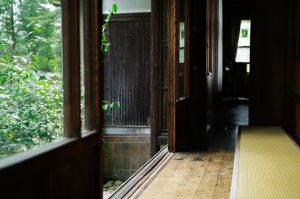
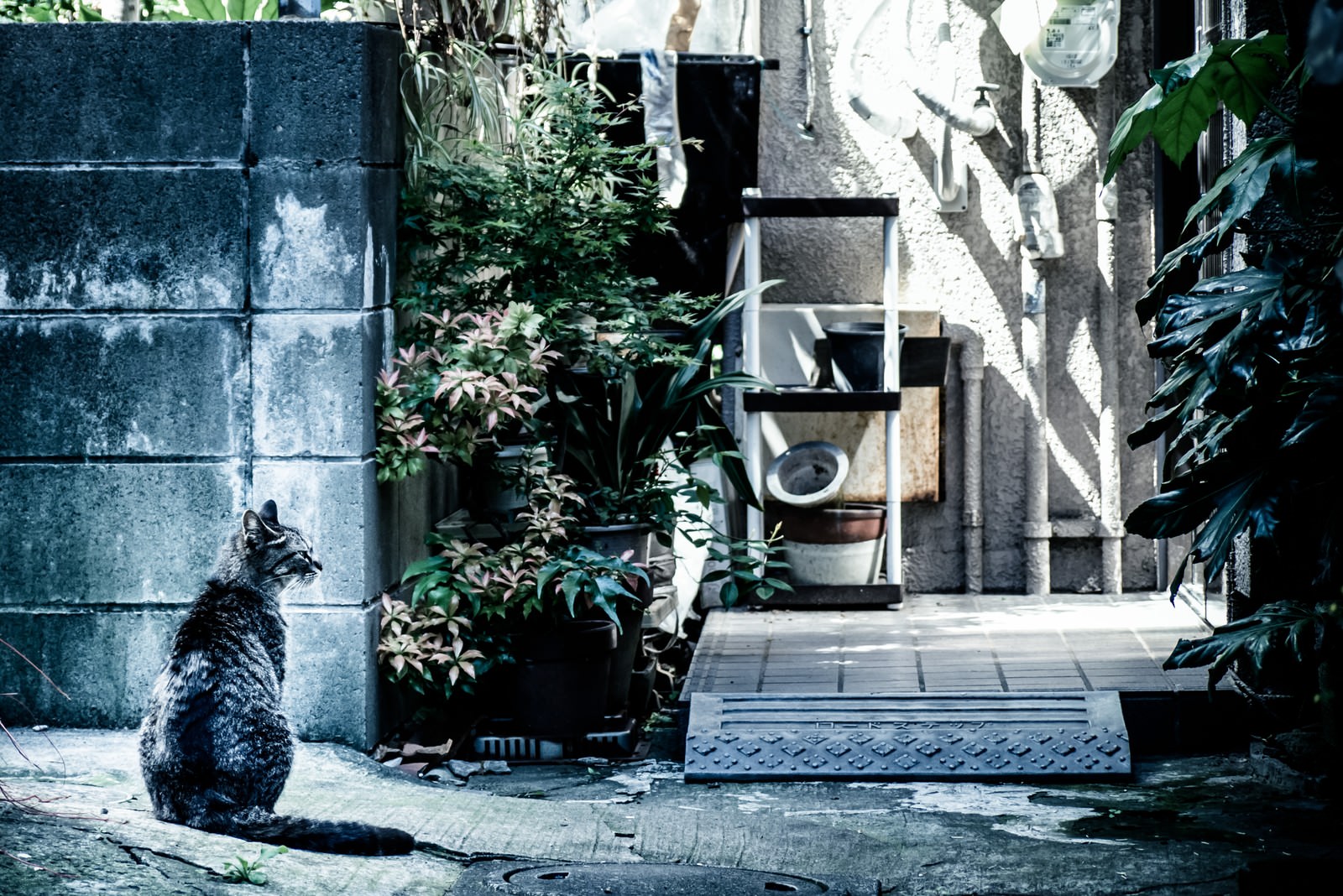
The alley was no wider than the span of his arms, lined with wooden houses whose walls carried the faint fragrance of soy sauce and grilled fish from nearby kitchens. A rusted bicycle leaned against a wall, and an old lantern swayed gently from the eaves of a small shop that might once have sold pickles or sweets. The hum of traffic receded, replaced by a softer silence broken only by the faint drip of water from a gutter.
And there, in the middle of the stone-paved path, lay a small cluster of cats.
One stretched luxuriously, its white paws extending toward the last rays of sunlight that slipped between the rooftops. Another, striped in gray, curled into a perfect circle, its breathing slow and steady as though time itself had slowed around it. A third simply sat upright, tail wrapped neatly around its feet, staring at the traveler with eyes that reflected the fading amber light.
The traveler stopped. He felt an immediate impulse to pull out his phone, to capture this image for later, but something held him back. The cats were so still, so unconcerned with his presence, that he sensed it would be almost disrespectful to break the spell with the click of a camera. Instead, he put the phone away and stood silently, absorbing the scene.
In the distance, he could still faintly hear the announcements of trains and the chatter of evening commuters. Yet in this little alley, time had thinned, stretched, and softened. The cats were not waiting for anything. They were not hurrying anywhere. They simply were. And in their being, the traveler felt a rare permission: the permission to stop, to linger, to exist without moving forward.
He realized that this alley, with its quiet feline guardians, was not merely a hidden corner of Tokyo. It was a portal into another rhythm of life, one in which minutes were not coins to be spent but water to be sipped slowly. Watching the cats, he felt an unspoken lesson: that surrendering to the flow of time, rather than fighting against it, could be a form of richness.
The traveler stayed longer than he expected. He leaned against the wall, listening to the faint sound of a wind chime, and let the minutes pass. As the cats yawned and shifted, the alley seemed to breathe with them. For the first time that day, perhaps for the first time in months, he felt his heartbeat slow to a gentler pace.
When he finally stepped back into the busy street, the world felt different. The noise had returned, but he carried within him the calm of the alley cats—a reminder that time could flow quietly, like a stream beneath the surface of life.
And so, from that small encounter, he began to see Japan differently. Not as a land of schedules and punctuality, but as a place where even the simplest creatures in the narrowest of alleys could teach the art of stillness.
Cats as Teachers of Stillness
When most people imagine Tokyo, they think of movement.
Trains gliding in and out of stations with perfect punctuality. Crowds flowing through Shibuya Crossing like a human tide. The constant flicker of advertisements and the background hum of vending machines, delivery scooters, and hurried conversations. Tokyo is a city of energy, efficiency, and ceaseless motion.
And yet, hidden within that rhythm are creatures who seem untouched by it: the alleyway cats.
They are not pets with collars and owners waiting at home. Nor are they strays in the Western sense, isolated and neglected. Rather, they are semi-wild residents of their neighborhoods, both independent and quietly cared for by the community. To encounter them is to meet beings who refuse to submit to the rush of the human world.
The Cat’s Philosophy of Time
A cat lying stretched across a sunlit stone step is not doing nothing. It is embodying something profound: stillness as a way of being. In Japanese alleys, where these cats choose their spots with calm authority, they become living demonstrations of a philosophy human beings often forget.
Humans measure time by clocks and schedules. We divide hours into units of productivity, believing that movement equates to purpose. But cats remind us that existence itself is meaningful, even without motion. Their stillness is not laziness—it is presence.
When a traveler stops to watch a cat groom its fur slowly, pausing to stretch, curling into a ball, then sleeping without concern for the bustling world outside, he is witnessing a lesson in “permission.” Permission to rest. Permission to be unhurried. Permission to live in sync with the body rather than the calendar.
The Gift of “Just Being”
In many cultures, stillness is associated with passivity or wasted time. But in Japan, stillness often carries depth. The pause between notes in traditional music, the silence in a tea ceremony, or the space between spoken words in conversation—all are considered as important as the action itself.
The alley cats seem to echo this cultural intuition. They do not strive to be noticed, yet they attract attention. They do not chase time, yet they are always exactly where they need to be. In their silent presence, they offer human observers a quiet liberation: the reminder that “being” can be more nourishing than “doing.”
Teachers Without Words
One of the striking things about cats is that they never explain themselves. They do not justify why they linger in the same spot for hours. They do not announce when they will move. They simply live. And in that living, humans find mirrors for their own lives.
A salaryman hurrying home might glance at a cat sprawled on a step and feel an unconscious envy. A child might sit down next to the cat and imitate its pose, learning without realizing that time can be savored. A foreign traveler might feel disarmed by the contrast between the rushing city and the quiet animal, realizing that wisdom can appear in the most unexpected teachers.
Cats do not instruct in words. They teach by refusing to conform. They embody a rhythm of life that is slower, softer, and deeply attuned to the natural flow of the day.
Stillness as Resistance
In a way, the presence of alley cats in Tokyo is a form of gentle resistance. They resist the logic of urgency. They resist the idea that value comes only from speed or productivity. They resist the compulsion to constantly move forward.
And yet, they do so without anger or rebellion. They resist simply by being what they are: creatures who rest, observe, and move only when necessary. In a city where people often feel they must always rush to the next appointment, the cats stand as reminders that life is not solely about acceleration.
A Quiet Invitation
When the traveler in the opening story stumbled upon the alley cats, he felt as if he had entered another world. But the truth is, the cats were not creating another world—they were revealing a layer of reality always present but often overlooked.
The invitation of the alley cat is simple but profound: Slow down. Stay awhile. Let time flow around you instead of chasing it.
By simply existing, they extend an unspoken gesture of companionship to anyone willing to pause. Their stillness becomes contagious, pulling the observer into a gentler pace. In this way, the cats are teachers—not of complex doctrines, but of something more fundamental: how to live quietly within the flow of time.
The Cultural Roots of Quiet Observation
The traveler who pauses in front of an alleyway cat may not immediately realize it, but what he is encountering is not just an animal resting in the sun. He is stepping into a much older and deeper cultural rhythm of Japan—one that treasures silence, subtlety, and the art of observing without interference.
The Japanese Aesthetic of Stillness
In Japanese aesthetics, stillness is never empty. Instead, it is charged with meaning. The concept of 「物の哀れ」(mono no aware)—the gentle sadness of impermanence—teaches that beauty lies not in permanence or grandeur but in fleeting, quiet moments. A falling cherry blossom petal. The sound of rain dripping from the eaves. Or, just as powerfully, a cat curled up in the corner of an alley, content within the moment that will inevitably pass.
Alongside this is the sensibility of わび・さび (Wabi-sabi), which appreciates simplicity, imperfection, and the dignity of things aged by time. The stray cat resting on an old wooden step, its fur blending with the worn textures of the neighborhood, is almost a living sculpture of wabi-sabi: unpolished, imperfect, yet profoundly harmonious with its surroundings.
These cats are not intruders in the alley. They belong to it, embodying the cultural appreciation of things that exist quietly, without forcing themselves into notice.
Zen and the Practice of Quiet Watching
The roots of this appreciation go back to Zen Buddhism. In Zen practice, silence and observation are central. To sit in meditation is to observe the self without judgment, to notice the passage of time without clinging to it.
In many ways, the alleyway cat mirrors this Zen discipline. Its long hours of apparent inactivity are not wasted—they are simply being. A Zen monk might see in the cat a kindred spirit, embodying the principle of 「無為自然」 (Mu-i shizen), the effortless naturalness of existence.
Tea ceremonies, too, reflect this philosophy. In the tea room, every gesture is deliberate, every pause intentional. The silence between movements is as meaningful as the movements themselves. Similarly, a cat that pauses mid-stretch, or remains still for half an hour watching dust motes dance in a shaft of light, embodies this same reverence for pauses as moments of fullness rather than absence.
Cats in Literature and Art
Japan’s cultural fascination with cats is not new. During the Edo period, woodblock prints often featured cats lounging in domestic spaces or wandering streets. Ukiyo-e artists such as Utagawa Kuniyoshi depicted cats with humor and affection, capturing their mischievous independence. Yet, even in playful images, the cat’s relaxed posture or languid gaze reflects the slow rhythm of everyday life.
In classical poetry, too, the presence of animals in stillness often served as metaphors for human emotion. A cat sitting quietly by the window could become a symbol of waiting, longing, or the serenity of solitude. Unlike in Western traditions where animals often symbolize action or power, in Japanese art the cat often represents patience and quiet companionship.
The Alley as a Cultural Stage
The Japanese alley, or 路地 Roji, itself carries cultural significance. Historically, these narrow streets were not only practical pathways but also intimate communal spaces where neighbors interacted at a slower rhythm than the main thoroughfares. Roji were places of pause—children played, elders exchanged greetings, and local shops formed bonds with customers.
That cats thrive in alleys is no coincidence. They, too, embody the slower, more personal pace of these spaces. Their presence turns the roji into a stage where timeless cultural values are acted out daily, often without conscious recognition. A passerby who stops to watch a cat is, in a sense, participating in this cultural ritual of quiet observation.
The Spiritual Resonance
Even 神道 Shinto, Japan’s indigenous spirituality, has echoes in this feline stillness. Shinto teaches that spirits, or 神 Kami, dwell in natural forms—trees, rocks, rivers, and even animals. To encounter a cat at rest in a shaft of evening light may stir in the observer a subtle awareness of kami, an unspoken reverence that transforms an ordinary alley into sacred space.
Thus, the quiet observation of cats in alleys is not accidental—it is deeply resonant with centuries of cultural sensibility. It is an expression of Japan’s way of seeing the world: valuing pauses, honoring presence, and recognizing beauty in what does not demand attention.
From Culture to Everyday Practice
This cultural backdrop explains why Japanese people often stop to watch or gently care for alley cats. Feeding them, leaving out water, or simply acknowledging their presence is not only an act of kindness but also a way of participating in a cultural dialogue about time, silence, and coexistence.
For the foreign traveler, this may seem like a small moment. But in reality, it is an encounter with the living threads of Japanese philosophy—threads woven through Zen, poetry, art, and everyday practice—that all converge in the simple, quiet figure of a cat in an alley.
Everyday Lessons from Alleyway Cats
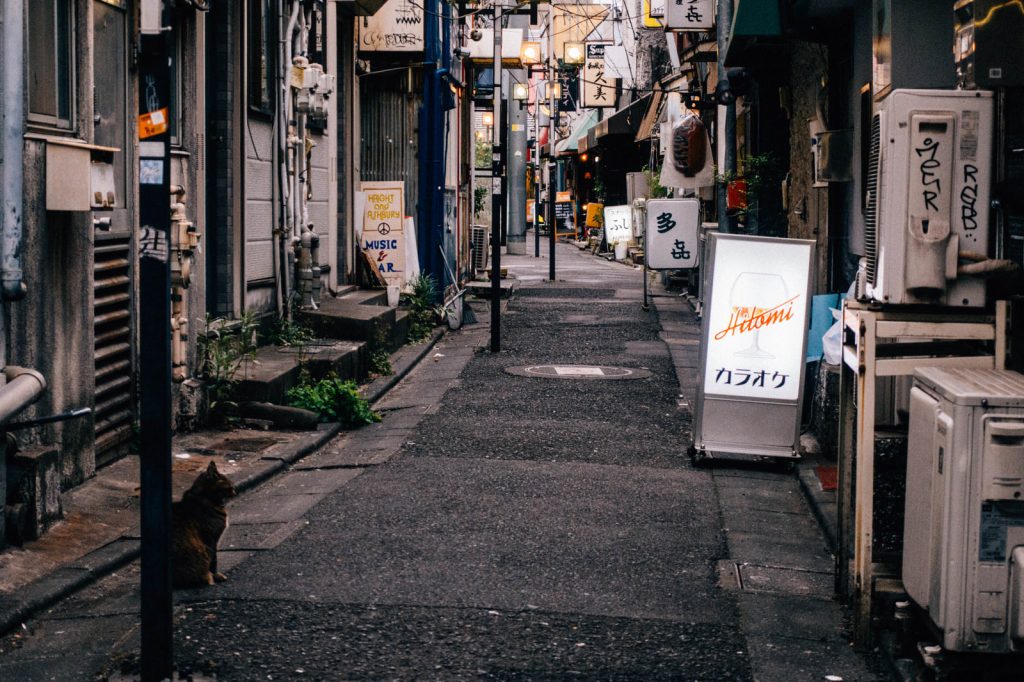
When travelers wander into the labyrinth of Japanese alleyways, they often expect to find ramen shops, lanterns, and perhaps the nostalgic sound of a shamisen spilling from a small bar. What they do not expect—but often remember most vividly—are the cats. These seemingly ordinary animals, lying on rooftops or curling up near bicycle tires, become quiet teachers. Through their presence, they reveal lessons about balance, patience, and the overlooked rhythms of everyday life.
Lesson 1: The Art of Stillness in Motion
In the heart of Tokyo, crowds surge toward train stations. Salarymen hurry, bicycles weave, scooters buzz, and yet, just a block away, a cat lies unmoved on a sunlit stone. The contrast is striking.
The lesson is clear: the world’s pace need not dictate your own. The cat’s refusal to be hurried by the rushing feet around it offers a gentle reminder: sometimes the wisest act is to stop. By doing nothing, by merely existing, the cat resists the tyranny of speed. For humans, who often equate worth with productivity, this is radical. But the cat shows that presence has value apart from motion.
Lesson 2: Belonging Without Possession
Unlike pets who belong to a household, alley cats occupy a liminal space. They are neither entirely wild nor completely domesticated. They belong everywhere and nowhere at once.
In Japan, neighborhoods often tacitly adopt these cats. A fishmonger leaves scraps, a retired woman sets out a bowl of water, children give them nicknames. Yet, the cat retains its independence. It comes and goes freely, never tied, never owned.
This teaches a subtle form of coexistence: one can belong without possession, participate without domination. For people who often struggle with the tension between independence and community, alley cats model a different balance—rootedness without chains.
Lesson 3: Continuity Amid Change
The alley changes constantly. Old houses are replaced by new apartments, vending machines are added, bicycles come and go. Yet the cats remain. The same tabby may sit year after year on the same low wall, watching generations of children grow taller.
This constancy is comforting. It suggests that amidst the whirl of modern transformation, some rhythms endure. The cat’s quiet vigil is a living thread that ties the past to the present. For residents, it reassures them that even as the neighborhood evolves, something of its spirit endures.
Lesson 4: Rest as Resistance
In a culture where hard work is prized, rest can sometimes feel like guilt. Yet the alley cat sleeps unapologetically—on steps, on shop roofs, even in the middle of pathways. Their naps are declarations: rest is not waste. Rest is survival.
In watching them, people are invited to reconsider their relationship to rest. A cat does not need justification for its nap, nor does it apologize for conserving energy. Perhaps humans, too, can reclaim the right to rest, not as indulgence but as wisdom.
Lesson 5: Trust Built Slowly
Cats do not rush into trust. They watch. They measure distance. They decide. A resident who feeds an alley cat may wait weeks or months before the animal dares to approach. But once trust is given, it is deep and lasting.
This lesson resonates in human relationships. True trust cannot be hurried. It takes patience, observation, and the quiet assurance of consistent presence. Just as the cat rewards patience with affection, so do human bonds deepen when cultivated slowly rather than forced.
Lesson 6: Shared Time as Community
On warm evenings, residents sometimes sit outside their doorsteps. A cat curls nearby. There may be no conversation, no direct interaction, yet the sense of companionship is unmistakable. The act of sharing time and space, without demand or agenda, is enough.
This quiet companionship reflects an often-overlooked aspect of love and friendship: presence is itself a gift. One does not need to entertain or impress; sometimes simply being there, like the cat, is the highest form of connection.
Lesson 7: Finding the Hidden Rhythm
Tourists rushing through Tokyo often miss this slower rhythm. But those who notice the cats begin to see the city differently. The alleys are no longer just shortcuts between destinations—they are places to pause, observe, and breathe.
The cats become guides, reminding both residents and visitors that the city has more than one tempo. Beneath the surface rhythm of urgency is another, quieter beat—the heartbeat of alleyways, of waiting, of life lived without haste.
Through these everyday lessons, alleyway cats transform from background figures into silent mentors. They remind us that stillness has value, that belonging does not require ownership, that rest is wisdom, and that trust grows slowly. For those who pause to watch, the cats become mirrors—reflecting a way of life that values presence as much as progress.
The Flow of Time They Embody
When we watch alleyway cats in Japan, what strikes us is not only their stillness but also the particular tempo they embody. They seem to exist in a different chronology—one that is not measured in minutes, deadlines, or productivity, but in cycles of light, warmth, hunger, and rest. Cats remind us that time can be lived, not just spent.
Linear Time vs. Cyclical Time
Modern life is dominated by linear time. We measure days in hours, hours in minutes, minutes in seconds. We move forward relentlessly, marking progress by tasks completed, goals achieved, or milestones reached. Time is a ladder we climb, each rung leading us away from the last.
But the cats in the alley embody a different vision: cyclical time. They wake with the sun, seek shade at noon, stretch at dusk, curl into stillness at night. Their lives are attuned not to clocks but to the rotation of the earth, the seasons, and the gentle cadence of need. Hunger comes and goes. Warmth fades and returns. Sleep and waking flow into each other.
This cyclical rhythm carries a profound lesson: life is not always about advancement. It can also be about return, recurrence, renewal.
The Morning Ritual
At dawn, when shop shutters begin to rise and the smell of miso soup drifts from kitchens, the alley cats stir. They stretch, shake the dew from their fur, and sometimes sit quietly, facing the rising sun. The scene is small but deeply symbolic.
For humans, morning is often about rushing: catching trains, answering emails, diving into work. For cats, it is about being with the light. They align themselves with something greater than schedule—the steady reappearance of the sun. Watching them, one is reminded that mornings can be a moment of quiet gratitude, a chance to feel the gift of another day.
The Midday Pause
By noon, the cats disappear into shadows. They nap beneath bicycles, on cool stones, or under wooden eaves. This midday retreat is not laziness; it is wisdom. The hottest part of the day is not meant for exertion. The earth itself quiets then, cicadas buzzing slower, air heavy with heat.
Humans, however, often resist this rhythm. We power through lunches, meetings, and endless activity. Yet the cats teach a different approach: to respect natural cycles of energy. Rest is not only permissible but necessary. In aligning with nature’s pause, they preserve strength for later, embodying a patience that humans too often ignore.
Dusk and the Shared Hour
Evening brings activity again. Shops light lanterns, families return home, and alley cats reemerge. They patrol familiar corners, greet one another with measured glances, and sometimes follow the fish-scent from small kitchens.
Dusk is communal for cats as it is for humans. It is neither the rush of morning nor the stillness of night, but a threshold. Here the cats remind us of the value of liminal time—the in-between moments that modern life tends to erase. Dusk is not for hurrying; it is for transition, for recognizing that endings and beginnings coexist.
Night and the Mystery of Silence
By night, alleys belong almost entirely to the cats. Humans retreat indoors, neon hums above, and shadows deepen. For the traveler who wanders at this hour, glimpsing a cat slipping between bicycles or sitting like a statue in the dark is unforgettable.
At night, cats embody the mystery of time—the sense that not all of it can be scheduled or controlled. Some hours are meant to be lived in silence, in uncertainty, in the unmeasured rhythm of presence.
The Circle of Seasons
Beyond the daily rhythm is the larger circle of seasons. In winter, cats curl tighter, conserving heat; in spring, they stretch in blooming courtyards; in summer, they vanish into shaded corners; in autumn, they bask in the fading warmth of sunlit stones.
Their bodies follow cycles humans often resist. We use air conditioners to erase heat, heaters to erase cold, artificial light to erase night. Yet the cats remind us that attunement to change is not weakness but harmony. Their lives embody an acceptance of impermanence that echoes Buddhist and Shinto philosophies: everything flows, everything shifts, and peace comes from moving with the cycle rather than against it.
Human Reflection: Relearning Forgotten Rhythms
When foreigners encounter these cats, they often notice the sensation of time slowing. This is not because the cats alter time itself, but because they reveal how much of human anxiety is tied to artificial measurement. To sit for even a few minutes and watch a cat breathe—slowly, steadily—is to remember that life is not a race but a rhythm.
The lesson is simple yet profound: we too can inhabit cyclical time. We can let our days breathe, let our lives include pauses, let our seasons teach us rather than fight us. Cats embody this naturally; humans can choose it deliberately.
In their silent movements, alley cats carry a wisdom older than clocks. They teach that time is not only linear, rushing us forward, but also circular, inviting us to return, to rest, to repeat. To watch them is to glimpse a gentler relationship with existence—one where time flows like water, not like a ticking machine.
Foreigners’ Encounters with Alleyway Cats
For many foreign visitors, Japan is first imagined as a land of contrasts: glittering neon and serene temples, bullet trains and ancient shrines, crowded intersections and tranquil gardens. What they often do not expect is to find cats—ordinary, unassuming alleyway cats—playing such a quiet role in their journey. And yet, these feline encounters become some of the most memorable experiences, precisely because they open a doorway into another rhythm of time.
A Surprising Presence in the City
Tourists walking through Shinjuku, Asakusa, or Osaka often expect to see bustling crowds and fast-paced urban life. But turn down a narrow side street, away from the main roads, and the pace shifts. Here, in the dim alleys, a cat may be perched on a wall, curled in a cardboard box, or stretched across a shop entrance.
For foreigners, this juxtaposition is striking. How can such serenity exist in the very heart of one of the busiest cities on Earth? The presence of cats reveals a hidden layer of Japanese life: beneath the surface rush is a slower, older pulse, one that has not been erased by modernization.
Many visitors describe this moment as a kind of discovery, as if they have stumbled into a secret that locals quietly share with the cats. The city has many faces, and the feline one is among the gentlest.
Not a Sign of Abandonment, but of Belonging
In some cultures, stray animals are often associated with neglect or abandonment. Foreign visitors might first assume that the cats in Japanese alleys are unloved, left to survive on their own. But soon they notice something different.
They see an old woman placing a small dish of fish at the corner. They notice shopkeepers leaving out water bowls in summer, or boxes lined with blankets in winter. They realize that the cats are not merely strays but members of the neighborhood, woven into the fabric of community life.
This realization changes the foreigner’s perception: the cats are not symbols of loneliness but of belonging. They are sustained not by ownership but by care, not by cages but by coexistence. For many visitors, this is deeply moving—a lesson in how compassion can exist outside the structures of possession.
A Shared Moment of Stillness
One of the most powerful experiences foreigners recount is locking eyes with a cat. It may last only a few seconds: the traveler pauses, the cat looks back, neither moves. Yet in that pause, time feels suspended.
In their home countries, life might be too busy to notice such moments, or people might feel awkward making eye contact with a stranger. But with a cat, there is no expectation, no demand. Just presence.
Many travelers describe this as a rare gift: to feel that they and the cat are, for a brief instant, inhabiting the same flow of time. It is not communication in words, but in stillness. The cat seems to say: “It’s okay to stop. It’s okay to be here.”
Stories from Travelers
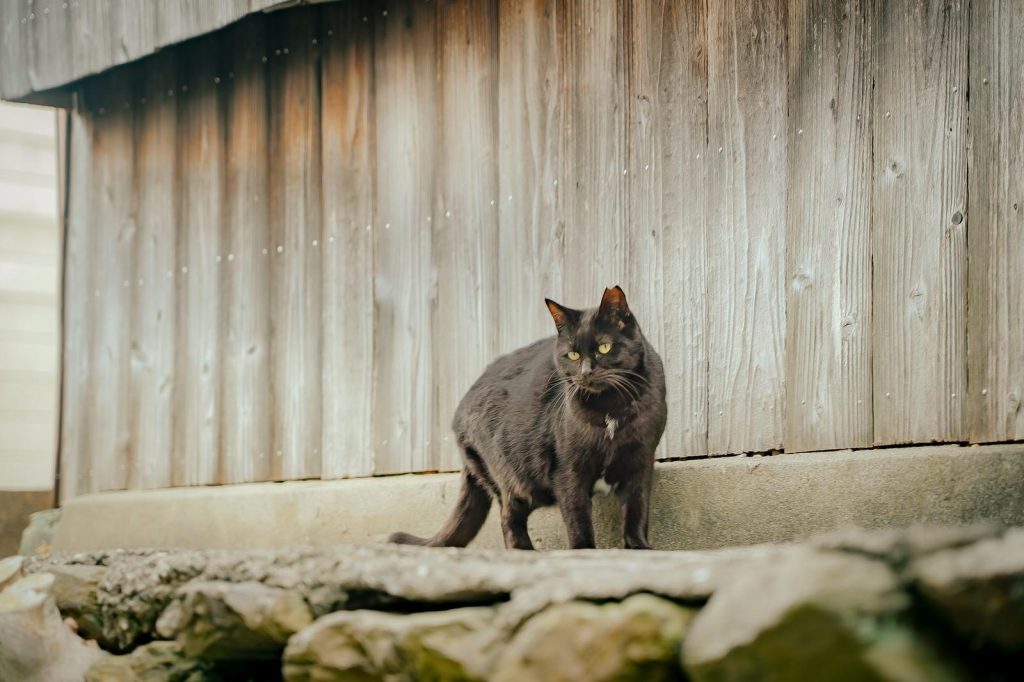
- A visitor from France recalled wandering Kyoto’s Gion district at night. The lanterns glowed, tourists bustled past, but in a side alley a black cat sat perfectly still. For ten minutes, she watched it groom itself slowly, utterly indifferent to the rush around it. She later wrote that this memory stayed with her longer than the temples or tea ceremonies—because it showed her a Japan that lives between breaths.
- An American traveler in Osaka described sitting on a bench, exhausted from sightseeing, when a tabby curled up beside him without hesitation. “I felt chosen,” he said. “Not because I offered food, but simply because I was still long enough.”
- A student from Germany recounted feeding a small calico in a Tokyo alley. Locals passed by without comment, as if it was completely normal. She was struck by how the cat belonged to everyone and no one, embodying a communal sense of care rare in her own urban experience.
These stories reveal a shared truth: for foreigners, alley cats are not just animals; they are cultural messengers, teaching something beyond language.
The Comfort of Unhurried Time
Foreign visitors, especially those from societies dominated by efficiency, often describe Japanese cats as embodying a comfort they had forgotten how to feel. In their home countries, waiting is often seen as wasteful, slowness as weakness. But in Japan, through these cats, they encounter a gentler perspective.
The cats show them that there is dignity in resting, grace in stillness, and richness in simply existing. For travelers caught in the whirlwind of sightseeing schedules and fast transport, this discovery is liberating.
A Quiet Lesson Carried Home
Long after they leave Japan, many foreigners carry with them the memory of these encounters. They might remember the soft sound of a cat’s paws on stone, the way sunlight spilled across fur, or the silent gaze that paused time. These memories become personal lessons, reminding them to slow down in their own lives.
Some even find themselves creating “cat moments” back home—sitting in parks longer, pausing to notice birdsong, or simply resting without guilt. The alley cats become invisible teachers, continuing their work across borders.
In this way, foreigners’ encounters with Japanese alleyway cats are not trivial at all. They are small but transformative, turning casual tourists into quiet students of time. Through the cats, visitors glimpse another way of being: not rushing to consume the world, but savoring it one still moment at a time.
Lessons for Modern Life
The alleyway cats of Japan are not philosophers in the human sense. They do not write treatises, give speeches, or design systems of thought. And yet, through the quiet rhythms of their lives, they offer guidance for the modern world—guidance that feels especially urgent in an age of speed, distraction, and relentless demand.
Lesson 1: The Courage to Rest
In contemporary society, rest is often seen as laziness. Productivity is idolized, schedules are overfilled, and even leisure must be optimized. In such a world, the simple act of pausing can feel rebellious.
Alley cats, however, embody rest without apology. They sprawl across stone steps, curl into sunny corners, or nap in front of busy shops, utterly unbothered by the rush of human life. They do not justify their rest; they inhabit it.
For us, the lesson is clear: rest is not a failure, but a form of resilience. By reclaiming the courage to pause, we protect our well-being and remind ourselves that our worth is not measured by constant motion.
Practical application:
- Take short breaks without guilt during work.
- Allow yourself time to nap, walk, or simply sit in silence.
- Redefine rest not as wasted time but as essential nourishment.
Lesson 2: The Wisdom of Unhurried Time
Modern culture often equates speed with efficiency and success. Quick responses, fast results, instant gratification—these are the currencies of the digital era. Yet what we gain in speed, we often lose in depth.
The alley cat is never in a hurry. It moves with deliberate slowness, stretching before it walks, pausing before it leaps, waiting until the moment feels right. This unhurried pace allows it to conserve energy, stay attuned to its environment, and avoid unnecessary mistakes.
For humans, the wisdom of unhurried time means recognizing that faster is not always better. Slowing down can lead to greater clarity, richer relationships, and deeper experiences.
Practical application:
- Eat meals slowly, savoring flavors instead of rushing.
- Walk instead of always driving or taking the fastest route.
- In conversations, allow silence instead of filling every pause.
Lesson 3: The Art of Being Present
Digital devices constantly pull us away from the present moment. Notifications, messages, and endless scrolling scatter our attention across multiple times and places, leaving us rarely here at all.
Cats, however, live entirely in the present. They do not worry about tomorrow or replay the past. When they watch a bird, they give it their full attention. When they nap, they are fully surrendered to sleep. Their presence is total, uncomplicated, and profound.
For us, learning presence means retraining ourselves to notice the world around us and to inhabit moments fully. Presence allows us to feel alive, to connect deeply with others, and to reduce the anxiety born of fragmented attention.
Practical application:
- Practice mindfulness: notice the texture of your food, the sound of rain, the warmth of sunlight.
- Put away devices during meals or conversations.
- Give undivided attention to one task at a time.
Lesson 4: Finding Balance Between Independence and Community
Cats embody a paradox that resonates deeply with modern life: they are both independent and connected. They roam freely, unowned, yet they also live within the support of the community. Shopkeepers feed them, residents watch over them, and travelers pause to acknowledge them.
For humans, this balance is essential. Too much independence can lead to isolation; too much dependence can erode individuality. Alley cats remind us that it is possible to be free and yet belong, to maintain autonomy while also sharing in the life of a community.
Practical application:
- Nurture personal boundaries while valuing communal ties.
- Offer support to neighbors or coworkers without expecting control.
- Celebrate individuality without severing connection.
Lesson 5: Redefining Time Itself
Perhaps the greatest lesson from alleyway cats is that time is not simply something to be spent or managed. It can also be savored, stretched, and shared.
Cats show us a rhythm of time that is cyclical rather than linear. They rest when they need, hunt when they must, and watch the world flow around them. Their sense of time aligns more with sunrise and sunset, warmth and coolness, hunger and satisfaction, than with clocks or deadlines.
For humans trapped in schedules and productivity charts, this perspective is revolutionary. It reminds us that life is not only about moving forward but also about dwelling deeply in each moment.
Practical application:
- Schedule “unscheduled” time—moments where nothing is planned.
- Align daily habits more with natural rhythms: rising with sunlight, winding down at dusk.
- Treat time not only as a resource but also as a companion.
Bringing the Lessons Home
When modern individuals embrace these feline-inspired lessons, life begins to shift:
- Stress softens as rest is reclaimed.
- Relationships deepen as speed gives way to presence.
- Communities strengthen as independence and care find harmony.
- The very texture of daily life becomes richer, slower, and more humane.
The cats do not preach these lessons. They simply live them, quietly, persistently, in the alleys of Tokyo, Kyoto, and countless other towns. For those who notice, they become teachers—not of words, but of time itself.
Closing Reflection: The Slow Gift of Feline Time
In the hurried avenues of the modern city, where footsteps echo with urgency and screens pulse with notifications, the alleyway cat lingers as a quiet contradiction. It does not run to catch the train, nor does it measure its life in deadlines and metrics. Instead, it embodies an ancient rhythm, one that whispers to us of forgotten truths: that time is not merely something to use but something to inhabit.
Watching a cat stretch lazily at dusk, or curl up in the warm hollow of a doorway, we are reminded of a gentler way of being. The cat does not hurry to justify its existence. Its life is not a performance of productivity. It rests, waits, watches, and moves when the moment is ripe. In doing so, it models a form of wisdom that we, as humans, often lose in the frenzy of achievement.
The slow gift of feline time is, at its heart, a gift of permission. Permission to pause without apology. Permission to wait without resentment. Permission to savor without guilt. Cats do not offer these lessons through sermons or structured teachings; they offer them simply by living, by being unhurried presences in a hurried world.
For the traveler who chances upon a cluster of cats in a Tokyo alley, the experience can be quietly transformative. In the middle of a city that never sleeps, one finds a pocket of stillness. The cats do not care about the next meeting, the next purchase, or the next social post. They simply remind us that life—real, breathing, luminous life—exists in the present moment, in the spaces between doing.
To take this gift into our lives is not to abandon responsibility or ambition, but to balance them with gentleness. It is to remember that rest is as vital as effort, that waiting can be as meaningful as acting, and that silence can be as rich as speech. The cats show us that in stillness, relationships deepen, creativity awakens, and the heart learns to breathe again.
And so, as we leave the alley and return to the hurried avenues of our lives, the memory of the cats lingers. It is a memory of fur catching the last light of dusk, of slow blinks that seem to carry trust, of a rhythm that refuses to be rushed. It is a memory that tells us, quietly but firmly, that time itself can be a form of love—if only we allow it to unfold gently, patiently, and with presence.
In the spirit of QuietTether, let us hold onto this teaching:
“Alleyway cats remind us that time is not only to be spent—it is also to be savored, stretched, and shared in stillness.”