Opening Story: The Train Ride into the Countryside
The train departed Tokyo Station with its familiar metallic chime and the subtle sway that accompanies the beginning of a long journey. For many passengers, this was simply another ride on the shinkansen, a marvel of Japanese engineering that carries people swiftly from one bustling metropolis to another. But for Daniel, a thirty-six-year-old traveler from London, the ride carried a different weight. He was not simply going from point A to point B. He was escaping, searching, and—though he did not yet have the words for it—slowly rediscovering a self he had misplaced in the grind of modern life.
Daniel had spent two exhausting years immersed in corporate projects that demanded every ounce of his attention. His phone was an appendage, buzzing at all hours with urgent messages that could never wait. The pandemic had blurred the lines between office and home, and his apartment in London had come to feel less like a sanctuary and more like an endless extension of the workplace. Even in moments of supposed rest, his mind whirred with unfinished tasks, with comparisons, with the quiet pressure to achieve more.
He came to Japan almost on a whim, inspired by little more than photographs of temple gardens and the vague recommendation of a colleague who told him, “If you want to reset, go there.” What he did not anticipate was that the reset would begin not in a temple, not in a hot spring bath, not in the hushed silence of a Zen hall, but on a moving train cutting across the spine of Honshu.
At first, the view through the wide shinkansen window was unsurprising: a blur of high-rises, office towers, neon billboards, and elevated expressways weaving their concrete patterns. Tokyo, in all its magnificent density, was hard to leave behind even as the train sped forward. But slowly, almost imperceptibly, the landscape began to shift. The skyscrapers grew shorter, replaced by clusters of modest homes. Apartment balconies gave way to tiled rooftops. The train passed over rivers where fishermen stood patiently, their lines disappearing into still waters that reflected the pale morning sun.
Daniel pressed his forehead lightly against the cool glass. Something inside him loosened, as if a tightly wound spring had been given permission to release. He had not realized how suffocating the endless vertical lines of the city had felt until they were replaced by the horizontal spread of rice paddies.
Within forty minutes, the scenery was almost unrecognizable from where he had begun. Vast stretches of farmland rolled out on either side, divided into neat squares and rectangles of green and gold. Farmers in wide hats bent low to the soil, their movements deliberate and unhurried. Beyond the paddies, mountains rose gently, their slopes thick with cedar and pine, the kind of green that seemed to breathe on its own. Occasionally, a small shrine appeared, perched at the edge of a field or tucked into the corner of a forest.
It was then that Daniel became aware of a quiet voice within himself, one he had ignored for years. It whispered—not loudly, not with urgency, but with a simple clarity—that he had been living in a way that erased him. Every deadline, every performance review, every scramble to stay ahead in competition had pushed him further from the person he once was. Here, in the transition from city to countryside, he recognized that absence. He realized, with a sharp pang, that he had lost sight of himself.
By the time the train slowed at a small rural station, the air already looked different—lighter somehow, less crowded, more transparent. Daniel stepped off the carriage with his backpack and a single rolling suitcase, and the first thing he noticed was the silence. Not the absolute silence of a void, but a textured one: the distant cry of a crow, the rustle of wind through nearby trees, the muffled voices of two locals greeting each other across the platform.
He inhaled deeply, and the air carried the faint scent of earth and wood smoke. In that breath, he felt something he had not felt in years: the possibility of beginning again. He did not know what form his journey would take, nor what he was supposed to learn. But he sensed—quietly, unmistakably—that this countryside platform marked not just a change of place, but the beginning of his return to himself.
The Journey of Losing and Finding the Self
Modern life, for all its conveniences and opportunities, often carries with it a silent erosion of the self. Many people wake up to the demands of alarms, meetings, obligations, and notifications before they have even had a chance to ask: What do I actually want today? Over time, this cycle conditions us to live not from the quiet compass of our own inner direction, but from the loud expectations of society, employers, and even friends or family. The “self” becomes less a source of guidance and more a performance—an actor on a stage that never allows for intermissions.
Daniel, the traveler in our opening story, was not unique in this. His exhaustion, his sense of having “misplaced himself,” is one that resonates with countless people across the globe. We live in a world that equates productivity with worth, visibility with success, and speed with value. Under such conditions, it is all too easy to confuse the noise outside with the voice within.
Losing the Self in the Rush of Modernity
The phenomenon of “losing oneself” does not happen in a single dramatic moment. It is gradual, almost invisible. You may recognize it in small signs:
- Answering emails late at night not because you must, but because you feel guilty if you do not.
- Scrolling endlessly on your phone, seeking a validation that never truly satisfies.
- Saying “yes” to commitments that leave you drained, while the things that once sparked joy gather dust.
- Feeling restless during quiet moments, because silence has become uncomfortable.
In these ways, life can become a perpetual performance. The true self—the one that once delighted in books, music, friendship, or simply the beauty of a sunset—becomes buried beneath layers of expectation and obligation.
The Japanese Pause: “Ma” as a Cultural Teacher
Here is where Japan offers a profound counterpoint. Embedded within its culture is the concept of Ma (間)—often translated as “interval,” “space,” or “pause.” In architecture, music, conversation, and daily life, ma is the recognition that emptiness is not a lack but a presence. The pause is not a void; it is an essential rhythm that gives meaning to what surrounds it.
When a traveler arrives in Japan, especially from a hyperactive urban environment abroad, they often notice how silence and stillness are not feared but respected. A pause in conversation is not immediately filled. A space in a garden is not seen as barren, but as integral to the whole design. A train ride through quiet countryside is not dead time, but an opening for reflection.
This cultural embrace of pauses teaches something vital: in order to rediscover the self, one must first stop. Not stop in the sense of quitting life, but stop in the sense of stepping out of the constant stream of demands and allowing silence to reveal what has long been ignored.
From External Validation to Inner Listening
Rediscovery often begins when attention shifts from the outside to the inside. In much of the modern world, people are trained to measure their worth by external markers—job titles, salaries, social media likes, or the number of projects completed. Yet, as many travelers in Japan discover, external validation rarely sustains inner peace.
Japan’s rhythms encourage a different mode of being. Instead of endless striving, one can find meaning in tending a small garden, participating in a tea ceremony, or simply observing the shifting of the seasons. Such practices invite a deeper kind of listening—not to others’ applause, but to the subtle voice that says: This is enough. This feels right. This is who I am.
A Universal Journey, Made Visible in Japan
What Daniel began to experience on the train ride—the recognition of his own absence—was not unique to him, nor to foreigners in Japan. It is a universal human journey: the oscillation between losing and finding the self. Japan, however, has cultivated cultural forms that make this journey visible, tangible, and approachable.
Whether through the stillness of a Zen temple, the deliberate movements of a tea master, or the seasonal rituals of everyday life, Japan offers a living reminder: life is not only about moving forward, but also about returning—returning to one’s own essence, one’s own still point.
And in that return, something beautiful happens. The individual is not only rediscovered, but renewed.
Landscapes as Mirrors of the Soul
When the train leaves the city and begins its glide into the countryside, something subtle yet profound happens: the traveler’s gaze softens. Towering skyscrapers and billboards, each shouting for attention, gradually give way to rice paddies, rivers glinting under the sun, and mountain ranges layered like brushstrokes on a painting. The shift in scenery is more than visual; it is psychological. It is as though the landscape itself is whispering: You may exhale now.
The Soul Reflected in Rice Terraces
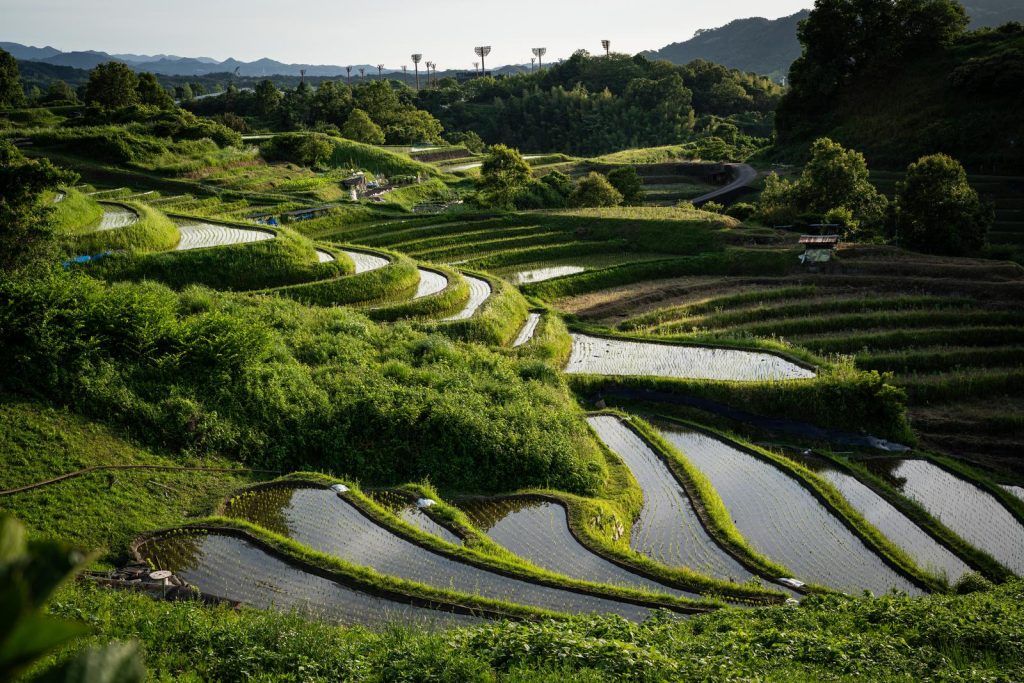
Few landscapes in Japan are as quietly moving as the Tanada 棚田—stepped rice terraces carved into hillsides. From a distance, they look like rippling patterns of green, each plot reflecting the sky in shimmering pools of water during planting season. What strikes many travelers is not simply their beauty, but the patience they represent. These terraces are not made in haste. They are the result of centuries of collective labor, adjusted carefully to the slope of the land, maintained season after season.
Standing before a tanada, one cannot help but feel time slowing down. The traveler may begin to notice that their own life, too, has been terraced—built in layers of experience, effort, and memory. The terraces seem to say: You do not have to rush. Life grows step by step, and each layer has its own quiet dignity.
Mountain Temples: The Ascent Within
Japan’s mountains are not merely physical formations; they are spiritual invitations. Scattered across ridges and valleys are temples and shrines that require a climb to reach. The ascent is often steep, punctuated by moss-covered steps and the sound of one’s own breath echoing in the stillness.
Travelers often describe such climbs as strangely revealing. Each step upward becomes a mirror for inner effort: the weight of one’s doubts, the discipline of persistence, and the release that comes when one finally reaches a wooden gate at the summit. At the top, the view stretches far beyond the temple grounds, and the soul feels stretched as well—expanded, clarified, humbled.
It is here that many realize the mountain is not only outside but inside. The journey upward reflects the journey inward. To reach the temple is not only to arrive at a sacred place, but to encounter a deeper stillness within oneself.
The Sea and the Shifting Horizon
Equally powerful is the Japanese coastline, dotted with torii gates that stand solemnly in the surf. Perhaps the most famous is the “floating” gate of Itsukushima Shrine on Miyajima, but countless others line less-known shores. These gates, half in the human world and half in the realm of the sea, suggest a boundary between the ordinary and the sacred.
For the traveler, standing before such a torii is an act of contemplation. The vastness of the ocean, always in motion, mirrors the inner tides of thought and emotion. The gate seems to say: There is no need to resist the flow. You are part of this movement, and it will carry you where you need to go.
Seasons as Teachers of Change
In Japan, the cycle of seasons is not just weather; it is a cultural rhythm. Cherry blossoms arrive briefly, scattering like soft confetti after only a week or two. Summer hums with cicadas, autumn bursts into fiery reds, and winter covers temples in silence and snow.
Each season teaches acceptance. The sakura whispers: Beauty is fleeting, and that is its power. Autumn leaves rustle: Change is inevitable; do not cling too tightly. Winter hushes: Rest is necessary, even in stillness there is life. Travelers often find that these natural rhythms illuminate their own lives. They begin to see personal struggles not as permanent conditions but as seasons—moments that will shift, fade, or transform in time.
The Inner Mirror
What makes Japanese landscapes so potent is not only their outward beauty but their ability to mirror inward states. The calm of a rice terrace reflects the longing for patience. The climb to a temple echoes the effort of self-discovery. The shifting ocean mirrors inner turbulence, while the seasons remind us that life is not static but always unfolding.
In this way, the traveler begins to sense that Japan is less about “discovering something external” and more about remembering what is internal. The landscapes do not impose meaning; they invite reflection. They do not demand awe; they offer companionship to the inner journey.
And in that companionship, the traveler begins to see themselves anew—not as someone lost, but as someone returning.
Encounters with Tradition
If the landscapes of Japan serve as mirrors of the soul, then its traditions function as gentle guides—rituals that point inward rather than outward, toward being rather than achievement. For many travelers, these encounters with Japanese tradition mark the moment when the rediscovery of self begins to take tangible form. They are not spectacles to be consumed; they are invitations to enter silence, attention, and humility.
The Tea Ceremony: A Quiet Rehearsal of Life
At first glance, the Japanese tea ceremony (Sado or Chanoyu) may seem like a performance: carefully measured gestures, precisely folded cloth, and an almost choreographed preparation of tea. But for the traveler sitting on tatami, waiting for a bowl to be placed before them, it soon becomes clear that this is not theater. It is a practice of presence.
Everything slows. The host’s movements are deliberate, yet without ostentation. The guest bows, lifts the tea bowl, turns it slightly, and drinks—not for taste alone, but for gratitude. A single bowl of tea becomes a microcosm of existence: there is effort, offering, reception, and completion. Nothing is hurried, nothing wasted.
The traveler may realize that this ceremony is not about perfection of form but perfection of attention. It is a quiet rehearsal of life itself—how to enter each moment fully, how to honor what is simple, how to meet others with respect. In that silence, the traveler begins to remember: Life is not about accumulation; it is about presence.
Zen Meditation: The Discipline of Stillness
If the tea ceremony teaches presence through action, then Zazen 座禅—Zen meditation—teaches presence through stillness. Sitting cross-legged in a temple hall, the traveler faces a blank wall. There are no instructions beyond breathing, no distractions beyond the restless mind.
At first, it feels impossible. Thoughts surge: memories of the city, worries of tomorrow, questions of self-worth. But under the quiet guidance of a monk, the traveler learns to watch thoughts without clinging to them. Breath rises and falls, time expands and contracts, and eventually there is a glimpse of something deeper—a silence that does not need to be created because it has always been there.
Zazen offers a startling lesson: the self that seemed lost was never gone. It was only buried under noise. To sit, to breathe, to allow the mind to settle is to uncover what has always been present: a stillness that belongs not to Japan alone, but to the human heart.
Copying Sutras: Writing as Reflection
Another tradition that many travelers encounter is Shakyo 写経, the hand-copying of Buddhist sutras. The traveler sits with brush and ink, tracing characters one by one. The words themselves may be unreadable to those unfamiliar with classical Chinese or kanji, yet the act of copying transcends language.
Each stroke demands patience. Each line requires attention. The brush does not allow rushing; haste results in smudges, while calm produces clarity. As the sutra takes form, the traveler realizes that they are not merely copying sacred text—they are copying themselves. Their state of mind is imprinted in the ink: agitation leaves uneven lines, calmness flows into balance.
By the end, the finished sheet is not just a reproduction of scripture; it is a mirror of the moment. The traveler sees, in black and white, who they were while writing—and perhaps who they are becoming.
Festivals: Collective Joy Without Competition
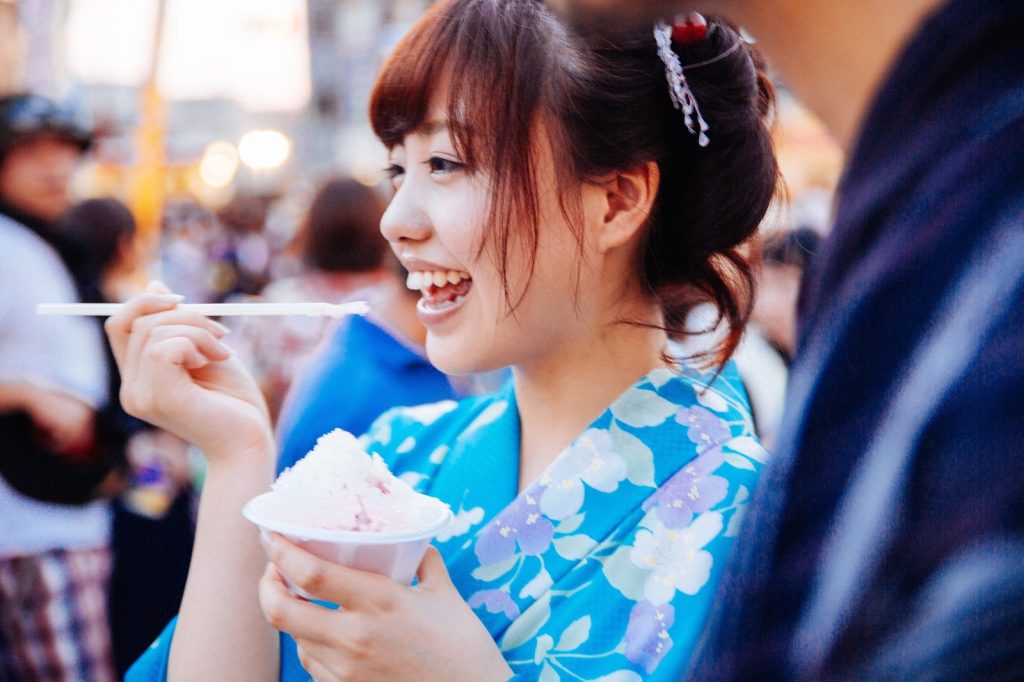
Not all traditions are solemn. Japan’s Matsuri 祭り (festivals) offer a different kind of rediscovery: joy without rivalry. Streets fill with food stalls, children carry paper lanterns, and floats adorned with drums and dancers move through towns. What strikes many foreign visitors is the absence of competition. The festival is not about winning; it is about sharing.
Here, rediscovery comes in the form of community. A traveler who has long measured their worth against colleagues or peers suddenly finds themselves welcomed into a circle of strangers, given a yukata to wear, and invited to join the dance. There is no stage, no audience—only participants. In that moment, the traveler learns that identity can expand, not through comparison, but through belonging.
Tradition as Inner Compass
What unites these diverse experiences—tea, meditation, calligraphy, festival—is that they all point inward. None exist to dazzle an audience or to display mastery. They are not performances for the outside world but practices for the inner one.
For the traveler who feels lost in the ceaseless demands of modern life, these traditions act as an inner compass. They do not demand that one become Japanese, or even fully understand every detail. Instead, they offer something more generous: a chance to pause, to reorient, and to remember the quiet core of one’s being.
In these moments, tradition ceases to be “culture” and becomes something far more personal: a way back to oneself.
Ordinary Moments, Extraordinary Clarity
Not every rediscovery of the self happens in temples or gardens. In fact, some of the most profound awakenings occur not in the extraordinary, but in the ordinary. Travelers often come to Japan expecting enlightenment in shrines, mountains, or tea rooms, only to find that the greatest clarity arrives in the small and unnoticed gestures of daily life.
These ordinary moments function like open windows—brief but illuminating glimpses into a way of being that has nothing to do with achievement, prestige, or spectacle.
A Can of Coffee on a Station Bench
Imagine a traveler stepping off a train in a rural town. They are tired from walking, perhaps uncertain of where to go next. At the platform kiosk, they purchase a canned coffee—a small, metallic cylinder warm to the touch. Sitting on a wooden bench, they open it, take a sip, and watch the quiet bustle of people around them.
There is nothing remarkable in this act. Yet, in that moment, something shifts. The sweetness of the coffee, the warmth of the can against their hands, the breeze carrying faint scents of pine—these details draw the traveler into presence. The rush of plans, comparisons, and self-judgments falls silent. They are simply there, existing, with no need to prove or achieve.
The lesson is subtle but profound: self-rediscovery does not always require rituals or discipline. Sometimes it is enough to pause, sip, and notice.
Conversations Outside a Convenience Store
Another ordinary moment unfolds late at night outside a convenience store. A group of locals—friends, workers finishing shifts, or students with bicycles—gather under the fluorescent glow. They stand casually, sipping drinks, talking softly, laughing occasionally.
For the traveler passing by, the scene carries an unexpected warmth. It is not a grand celebration, yet it radiates belonging. Nobody is striving to outshine the other. Nobody is rushing away. The traveler realizes that identity, so often tied to performance and productivity, can also be rooted in simple presence with others.
This scene teaches that clarity does not always arrive through solitude; it can emerge from observing how people inhabit ordinary togetherness.
A Bowl of Noodles at a Roadside Shop
On another day, the traveler stops at a roadside ramen shop. The interior is plain: wooden counter, stools, a steaming pot, the clatter of chopsticks. They order, wait, and receive a bowl—broth rising in fragrant steam. The noodles are not famous, the place is not listed in any guidebook, yet the taste feels deeply restorative.
In that moment, the traveler sees how nourishment itself can be a form of rediscovery. Eating not for status, not for photographs, but simply to be sustained. Each mouthful is a reminder that life’s essentials—warmth, food, shelter, connection—are often already present.
Silence on a Side Street
Perhaps the deepest clarity arrives when the traveler wanders down a side street. The main road is filled with shops and voices, but the alley is still. Laundry sways from a balcony, a cat stretches in sunlight, wind rustles the leaves.
Standing there, the traveler realizes that this stillness mirrors an inner one. They are not “doing” anything, yet they feel whole. What was thought to be lost—the sense of self—has been waiting all along, in the space between noise.
The Extraordinary Hidden in the Ordinary
The significance of these moments is not their rarity, but their accessibility. Anyone can buy a canned coffee, share a laugh outside a convenience store, or walk down a quiet street. These experiences reveal that rediscovery is not a distant goal but an ever-present possibility.
To live with clarity does not require escaping life. It requires entering it fully—even in its smallest gestures. In this way, Japan teaches that the ordinary is not the opposite of the extraordinary; it is the very doorway to it.
Foreigners’ Stories of Rediscovery
The rediscovery of the self in Japan is not merely a poetic abstraction—it is something that countless travelers, workers, and students have experienced firsthand. Their stories show that the lessons of Japan are not reserved for sages or seekers, but are accessible to anyone who arrives with openness. Each tale is unique, yet all echo the same quiet truth: in the spaces between competition, noise, and speed, a more authentic self can emerge.
The Traveler Who Found Herself in the Countryside
Emma, a graphic designer from London, had been exhausted by the relentless pace of city life. She traveled to Japan with the vague hope of “getting away,” but did not know what exactly she was seeking. After spending a week in Tokyo, she boarded a train north into the countryside.
It was there—in a quiet mountain village where the air smelled of cedar—that she realized how deeply she had been living through the eyes of others. Nobody in the village cared about her portfolio, her Instagram presence, or her achievements. They only cared whether she was warm, whether she had eaten, whether she had enjoyed the hot spring.
On the second evening, watching fireflies by a river, Emma whispered to herself: “I don’t need to impress anyone to be whole.” That night, she wrote in her journal not about goals, but about feelings. She returned home not with souvenirs, but with a renewed gentleness toward herself.
The Businessman Who Learned to Pause
Michael, an executive from New York, first came to Japan for work. His calendar was filled with meetings, negotiations, and late-night emails. He admired Japanese efficiency but was puzzled by moments of deliberate slowness—the bow at the start of meetings, the long silences before decisions, the lingering at the table after meals.
One evening, his Japanese colleagues invited him to a small izakaya. Instead of discussing quarterly reports, they spoke of their families, the changing seasons, and memories of childhood festivals. Michael felt awkward at first, but then realized that these pauses were not inefficiencies; they were expressions of care.
In that stillness, he rediscovered a part of himself that had long been buried: the capacity to listen without rushing, to value people not for outcomes but for presence. Later he reflected, “Japan taught me that success isn’t only about acceleration. Sometimes the most important thing is to slow down enough to notice who is beside you.”
The Student Who Reconnected with Her Dreams
Aya, a second-generation Japanese-American student, came to Kyoto for a year of study abroad. She had grown up balancing two cultures, never quite sure where she belonged. At university, she felt pressure to choose a “practical” career path, even though her true passion was in painting.
In Kyoto, she joined a local art circle. The members were not professionals—some were retirees, others part-time workers—but they gathered weekly to paint landscapes and exchange encouragement. Nobody competed. Nobody ranked. Aya felt liberated.
As she painted the mossy stones of a temple garden, she realized that her dreams were not foolish. They were part of her. Returning home, she did not abandon responsibility, but she no longer dismissed her love of art. Japan had given her permission to honor what was already inside her.
The Family Who Rediscovered Togetherness
Not all rediscovery happens alone. One Canadian family shared how their trip to Japan transformed them as a unit. They had come for sightseeing, but what they remembered most was an evening in a small town where they rented bicycles and rode along rice fields at sunset.
There was no rush, no agenda. They stopped at a tiny shop for ice cream, laughed at getting lost, and watched the sky turn gold. Later, the parents said, “We realized we don’t always need big adventures. We just need to be together, without rushing.”
This ordinary ride became their most treasured memory—proof that rediscovery can be communal, not just individual.
A Shared Thread
These stories differ in setting and detail, but they converge on a simple realization: Japan’s rhythms, traditions, and landscapes encourage people to pause long enough to hear themselves again.
Whether it is a designer in the countryside, a businessman in a quiet izakaya, a student in an art circle, or a family on bicycles, the rediscovery is never about becoming someone new. It is always about remembering what was forgotten in the noise of modern life.
Lessons for a Universal Journey
The experiences of rediscovery in Japan are deeply personal, yet they carry lessons that resonate far beyond the boundaries of culture or geography. They are not simply “Japanese” truths, but human truths—reminders that the search for self is universal, and that slowing down, listening inwardly, and reconnecting with what matters are needs that transcend nationality, profession, or age.
1. The Necessity of Losing Ourselves
In many societies today, particularly in the fast-paced world of global cities, people live under constant pressure to perform, achieve, and define themselves through measurable success. Work titles, financial status, social media influence—these often become the metrics by which identity is shaped.
Yet there is a paradox: in striving to secure a self, many people lose it. They become fragmented, anxious, and disconnected from their inner voice. Japan’s example suggests that losing oneself may not be a failure, but a stage in the human journey. Rediscovery is only possible because of prior loss. To wander, to forget, to feel disoriented—these are not signs of weakness, but invitations to begin again.
2. Stillness as a Universal Medicine
One of the strongest lessons Japan offers is the power of stillness. In tea ceremonies, in temple gardens, in the quiet of a countryside train station, stillness is not emptiness. It is fullness. It creates space for awareness to return.
In a world addicted to motion, stillness can feel foreign, even frightening. But the testimonies of travelers show that this stillness is deeply healing. It is not uniquely Japanese; it is universally human. Every culture has, at some point, known the value of silence and pause—whether in meditation, prayer, or simply watching the sunset. To rediscover the self requires re-learning this medicine.
3. Nature as Teacher
Another universal lesson is the wisdom of nature. Japan’s seasons, landscapes, and rituals tied to the earth remind people that identity is not an isolated construct but something woven into a larger web of life.
Standing before rice terraces, or listening to cicadas in midsummer, foreigners realize that their struggles and ambitions are part of something wider and more timeless. The universal insight is this: by aligning with nature’s rhythms, we rediscover our own. A human being is not separate from the mountain, river, or wind; to forget this is to forget oneself.
4. Everyday Moments as Gateways
Perhaps the most profound rediscovery is that it need not happen in dramatic settings. A can of coffee on a train platform, a small kindness from a stranger, the sight of laundry swaying in the breeze—these ordinary moments contain extraordinary clarity.
Japan simply makes these moments visible because its culture allows them to breathe. But the lesson is universal: the sacred hides in the everyday. Rediscovering oneself does not require traveling far, nor practicing elaborate rituals. It requires attention. It requires the courage to see meaning where one might otherwise pass by.
5. From Competition to Coexistence
In many modern contexts, identity is shaped in competition—being the best, ranking higher, standing out. Japan’s non-competitive beauty suggests another path: identity can also be shaped in coexistence. You do not need to defeat others to be whole; you can exist alongside them, in harmony, and still shine.
This is a universal teaching with profound psychological impact. When we see others not as rivals but as companions, rediscovery of the self becomes less anxious and more generous. Life is not a race, but a shared unfolding.
6. Practical Lessons for Modern Life
What, then, can someone outside of Japan take from these stories? The lessons are many, but they can be summarized in simple practices:
- Prioritize pauses: Schedule time not for productivity, but for silence. Walk without your phone. Sit in a park without an agenda.
- Notice nature: Even in a city, the sky changes color, the wind shifts, and leaves fall. Pay attention, and let those rhythms anchor you.
- Honor ordinary rituals: Make tea slowly. Eat without multitasking. Greet someone with full presence. These small acts return you to yourself.
- Shift from comparison to connection: Instead of asking, “Am I better than them?” ask, “How are we walking together?” This softens the ego and nourishes belonging.
- Remember that rediscovery is cyclical: You will lose yourself again, and again you will rediscover. This is not failure but the rhythm of being human.
7. A Universal Invitation
The rediscovery of the self in Japan is not an exotic miracle reserved for visitors to temples or villages. It is a mirror. Japan simply provides conditions where what is forgotten becomes visible again. But the invitation is open to all, everywhere.
Each person, no matter their background, carries within them a quieter self—patient, enduring, waiting to be remembered. The universal lesson is not that one must go to Japan, but that one must allow oneself to see, to feel, and to pause wherever they are.
Closing Reflection: Coming Home to Yourself
The traveler who stepped off the train in the countryside discovered more than a new place—he rediscovered himself. That moment of breathing in clear air, of seeing mountains rise against a quiet sky, was not about becoming someone new. It was about remembering what had always been there, beneath layers of fatigue, expectation, and noise.
Japan does not give people an identity. It simply removes the clutter that hides it. Through stillness, nature, tradition, and ordinary encounters, it whispers a truth that is easy to forget in a competitive, hurried world: you already are enough. You do not need to win to be worthy. You do not need to transform to be whole. You only need to return.
This is why rediscovery is not about searching endlessly for something missing. It is about realizing that the self we thought was lost has been quietly waiting. Like a tatami room where silence lingers even after footsteps fade, or a temple bell that resonates long after its sound is struck, the self endures.
And so the journey ends where it began: not in a distant place, but at home—within.
QuietTether’s philosophy speaks gently to this:
“To rediscover yourself is not to find something new, but to return to what has always been within you—quiet, patient, and waiting to be remembered.”