
Opening Story: The Unfinished Garden
It was a cool afternoon in early spring when Daniel, a traveler from the United States, found himself walking along a stone path that wound gently through a Japanese garden in Kyoto. He had seen photographs of these gardens before—images in glossy travel magazines and design books that praised their sense of harmony and peace—but standing within one was something entirely different. The air itself felt different: quieter, softer, as though even the wind had been trained to respect the serenity of the place.
Daniel had expected a sense of perfection. He imagined the garden would be symmetrical, immaculately ordered, a triumph of human design over the wildness of nature. But as he wandered deeper, he noticed something unexpected. The pond, though carefully shaped, had a rock at one edge that seemed oddly tilted, almost as if it had been left that way by accident. The stepping stones were arranged with deliberate irregularity: one large, one small, then a slightly slanted one. Even the raked gravel, though elegant in its swirls, contained small patches of moss breaking through, like green whispers interrupting silence.
At first, Daniel thought it was simply neglect—that perhaps the garden was old, and time had softened the edges of human control. But when he looked closer, he realized it was not carelessness. The irregularity was intentional, the asymmetry deliberate. Everything had been arranged with precision, and the imperfections were themselves part of the design.
A local guide, a soft-spoken woman in her fifties named Yumi, approached and smiled knowingly. She had seen this expression on foreign visitors many times before—the slight furrow of the brow that betrayed a question unasked.
“You see,” she said gently, “Japanese gardens are not meant to be perfect. They are meant to leave room—for the imagination, for the heart, for the passage of time. The gaps, the spaces, the unfinished parts… they are not mistakes. They are invitations.”
Daniel tilted his head. “Invitations?”
“Yes,” Yumi continued, leading him toward a small wooden pavilion overlooking the pond. “When something is too perfect, too complete, the mind stops. There is nothing left to wonder about, nothing left to feel. But when there is space—when something is slightly unfinished—it allows you to enter. It leaves you a place to breathe, to bring your own heart into the picture.”
They sat together, gazing out at the still water where a single carp swam lazily, tracing arcs of orange against the muted green reflection of the pines. The quietness pressed in, but it was not oppressive. It was expansive, like standing inside a silence that had depth.
Daniel thought about his own life back home. His calendar was always full—meetings stacked on top of one another, evenings planned weeks in advance. Even his vacations were packed with itineraries: museums, restaurants, sightseeing from dawn to dusk. He realized how little room he left for the unexpected, for pauses, for simply being. His heart, like his schedule, was often overfilled, leaving him restless and exhausted.
Yumi poured tea from a small thermos she had carried with her. She handed him a cup and spoke with the same calmness that seemed to flow from the garden itself.
“In Japan, we believe in the beauty of ma—the space between things. In a garden, in music, in conversation, in life. It is the space that gives meaning to form. Without emptiness, fullness has no value. Without silence, sound has no beauty. Without pause, movement has no rhythm.”
Daniel held the tea in his hands, letting the warmth seep into his palms. For the first time in years, he allowed himself to do nothing but sit, listen, and look. He noticed the way the branches of a cherry tree arched over the pond—not perfectly balanced, but leaning just slightly, as though inviting him to lean, too. He noticed how the gravel patterns drew his eyes outward, then stopped, as if leaving the journey for him to continue in his own mind.
He felt something soften inside him. A thought rose unbidden: Maybe I don’t need to fill every corner of my life. Maybe leaving room is not emptiness, but possibility.
Yumi, sensing his reflection, smiled again. “An unfinished garden,” she said, “is like an unfinished heart. It leaves space for what is to come, for what we cannot yet see. It leaves room for life.”
Daniel took a slow sip of tea, breathing deeply. In that moment, he understood something he had never known he was missing: the wisdom of leaving room—not just in gardens, but in his heart.
The Japanese Concept of Ma (間)
When Daniel left the garden later that day, the word Yumi had spoken—ma—lingered in his thoughts. At first, it seemed simple: space, pause, emptiness. But as he began to notice its presence throughout Japan, he realized that ma was not emptiness at all. It was fullness of a different kind—a fullness made possible only by restraint, by choosing not to fill every gap, every silence, every corner.
Ma in Japanese Philosophy
In Japanese, the character 間 (Ma) is composed of two elements: the gate (Mon 門) and the sun (Hi 日). Together, they depict the sunlight filtering through the crack in a gate—a fleeting presence, a moment of light made possible only by the space of the opening. The concept cannot be translated neatly into English. Words like “gap,” “interval,” or “pause” all fall short, because ma is not simply the absence of something. It is the living presence of space itself.
The roots of ma can be traced to both Buddhist and Shinto thought. From Buddhism comes the idea of impermanence—the recognition that all things are transient, that clinging too tightly leads to suffering. In this view, ma is a reminder that incompleteness is not a flaw but a reflection of life’s true nature. From Shinto comes reverence for natural harmony, the belief that beauty arises not from human control alone but from coexistence with what is beyond our grasp. Together, these influences shape ma into a philosophy of balance: the wisdom of leaving room, so that life itself can enter.
Ma in the Arts: Music, Noh, and Tea
One of the clearest places to experience ma is in Japanese music. In Western classical tradition, music often aims for continuity: phrases flow into one another, filling the space with sound. In contrast, traditional Japanese music is woven with silences. The Shakuhachi 尺八 (bamboo flute) is famous for its breathy tones, each note separated by pauses that allow the sound to dissolve into silence before the next begins. These pauses are not interruptions; they are as essential as the notes themselves. To a Japanese ear, the silence is part of the melody.
The same principle shapes the art of Noh theater. To a first-time foreign visitor, a Noh performance may seem unbearably slow. The actors move with glacial deliberation, pausing after each gesture, each chant. But within those pauses, the audience is invited to lean inward, to listen beyond words, to feel the weight of time itself. What is not spoken, what is not shown, becomes as powerful as what is. The silence between drumbeats, the stillness between movements, draws the viewer into an encounter that transcends performance.
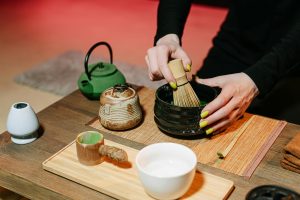
In the tea ceremony, ma is the unspoken rhythm that guides every action. The host does not rush to fill the silence with chatter. Instead, the preparation unfolds with quiet precision: the scooping of the tea powder, the pouring of the water, the whisking that creates a froth. Between each action lies a pause, a breath, a space that allows both host and guest to settle into presence. The ceremony is less about drinking tea than about dwelling in the intervals—experiencing the richness of what happens when nothing “extra” is added.
The Wisdom of Restraint
Western culture often celebrates abundance, expansion, and saturation. A full orchestra crescendos into sound, a conversation fills every silence, an artist covers the canvas completely. But Japanese aesthetics suggest a different kind of wisdom: beauty is not in the saturation, but in the restraint. By leaving something unsaid, something unfilled, the imagination awakens.
This is why in Japanese ink painting (Sumi-e 墨絵), vast portions of the paper are left blank. The white space is not empty; it represents mist, sky, or the unseen. The few strokes of ink suggest a mountain, a river, a tree—but the rest is entrusted to the viewer’s mind. The painting does not tell the whole story; it leaves room for the heart of the observer to complete it.
Even in architecture, Ma is honored. Traditional Japanese rooms are sparse, with sliding doors that open to reveal wide spaces rather than cluttered interiors. The emptiness is intentional, offering flexibility: the same room can be a bedroom at night, a dining room during the day, a ceremonial space when guests arrive. The emptiness is potential, not lack.
The Everyday Presence of Ma
What struck Daniel most after learning about ma was that it was not confined to gardens, art, or performance. It was woven into everyday life. He noticed it in conversations: people did not rush to respond immediately. A pause after a question was not a sign of ignorance or hesitation, but of respect—a willingness to listen, to let words settle before replying.
He noticed it on trains: the quietness of passengers, the way silence itself was part of the shared experience. He noticed it even in shops, where clerks often allowed moments of pause between phrases, rather than filling every second with chatter.
In each case, ma gave space for presence. It created a rhythm of life that was less about constant motion and more about breathing in and out. It was not passive or weak, but deliberate—a discipline of not overcrowding the moment.
Ma as Wisdom for the Heart
The more Daniel reflected on Ma, the more he understood Yumi’s words in the garden. Ma was not just an artistic principle or cultural habit. It was wisdom for the heart. When we leave no space—when we fill our days, our conversations, our minds to the brim—we suffocate. We lose the ability to notice, to feel, to connect. But when we leave room, when we allow gaps and pauses, we invite life itself to flow in.
In that sense, the unfinished garden was a metaphor not only for Japanese aesthetics but for the human soul. To leave room in the garden is to leave room in the heart: space for others, space for change, space for the unexpected grace of life.
Why We Fear Emptiness
Daniel began to realize something unsettling as he walked through the streets of Kyoto after leaving the garden: ma was beautiful, but it also felt unfamiliar. In his own culture, silence often made him uncomfortable. Empty spaces seemed awkward, incomplete, even threatening. He thought of business meetings back home where silence meant failure—someone hadn’t prepared well enough. He remembered dinners with friends where lulls in conversation had everyone scrambling to say something, anything, just to fill the void.
Why, he wondered, do we fear emptiness so much?
The Western Association: Emptiness as Lack
In much of the Western worldview, emptiness is equated with deficiency. An empty house means loneliness. An empty calendar signals insignificance. An empty bank account spells danger. The very word “empty” is laced with negativity. To be “full” is to be successful, secure, satisfied. To be “empty” is to be poor, deprived, or lost.
This cultural orientation shapes daily habits. People pride themselves on being busy, their schedules crammed with obligations. Free time is seen as wasteful, even shameful. In corporate culture, “idleness” is condemned, and productivity is measured by how completely one’s time is filled. The phrase “time is money” captures this ethos: every unoccupied moment is an economic loss.
In conversation, silence carries the same stigma. If someone pauses too long before responding, others grow uneasy. Silence is misread as incompetence, lack of confidence, or even hostility. The result is a cultural habit of filling every gap with words—whether necessary or not. Small talk, filler phrases, constant chatter: these are not just social lubricants but shields against the awkwardness of emptiness.
The Psychological Roots of the Fear
Why do humans resist emptiness so strongly? Psychologists suggest that beneath the cultural layers lies a universal human fear: the fear of being left alone with oneself. Emptiness exposes us to silence, and in silence we encounter thoughts and emotions we often avoid. In a quiet room, anxieties surface. In an unscheduled afternoon, boredom arrives, and beneath boredom, perhaps loneliness.
Filling every gap with activity or sound becomes a defense mechanism. If we are busy, we don’t have to confront what lurks beneath. If we are constantly talking, we don’t have to sit with the discomfort of not knowing what to say—or worse, with what the silence might reveal about our relationships.
In this way, emptiness threatens the fragile structures we build to protect ourselves. To sit in silence with another person is to risk vulnerability: do we really have enough connection to withstand the absence of words? To leave space in our schedules is to risk asking: who am I, if I am not constantly doing?
Emptiness as Weakness in Modern Culture
In modern societies driven by competition, emptiness is often confused with weakness. The strong are those who conquer space, who dominate time, who fill every void with achievement. The weak are those who “have nothing,” who remain silent, who leave things unfinished. This worldview explains why so many people fear under-scheduling, why they rush to fill conversation, why they dread being perceived as idle.
The irony, of course, is that this frantic avoidance of emptiness often leads to exhaustion. A schedule with no space collapses under its own weight. A conversation with no pauses becomes shallow. A life with no emptiness leaves no room for meaning.
The Japanese Reframing: Emptiness as Fullness
What Daniel discovered in Japan was that this fear was not universal. In Japanese culture, emptiness is not interpreted as lack. Instead, it is seen as potential. A blank space in a painting invites imagination. A pause in music deepens emotion. A silence in conversation honors the weight of what has been said. An unfilled corner of a garden allows the heart to breathe.
Where Western culture sees deficiency, Japanese aesthetics see opportunity. Where the West hears awkward silence, Japan hears resonance. Where the West fears incompleteness, Japan values the humility of leaving things unfinished.
Daniel’s Reflection
As Daniel thought about his life back home, he realized how often he had avoided emptiness—filling his calendar, stuffing his conversations, decorating his apartment, consuming endless information online. He had never considered that what he avoided might itself be the source of wisdom. Perhaps emptiness was not something to fear, but something to embrace. Perhaps silence was not awkwardness, but presence. Perhaps leaving room was not weakness, but strength.
He remembered Yumi’s words again: “The emptiness is where your heart finds space to rest.”

Everyday Practices of Leaving Room
When Daniel began to pay closer attention to Japanese daily life, he noticed that the wisdom of leaving room was not confined to gardens or temples. It was woven quietly into ordinary interactions, into the way people spoke, wrote, and related to one another. What once seemed like gaps or unfinished gestures revealed themselves as intentional acts of gentleness—spaces left open for others to breathe, to feel, to belong.
Silence in Conversation
One of the first things Daniel realized was how differently silence functioned in Japanese conversation. Back home, he had always rushed to fill pauses, worried that quiet moments signaled awkwardness or disconnection. In Japan, however, silence often carried meaning of its own.
He observed two elderly men sitting in a teahouse, sharing long stretches of quiet between sips. They were not avoiding each other, nor struggling to find topics. Their silence was comfortable, almost companionable, as though words were not needed to affirm their bond.
Later, a Japanese colleague explained: “Silence is also communication. It gives space for feelings that words cannot capture. It shows respect for what has already been said.”
Daniel began to experiment with letting silences linger. At first it felt uncomfortable, but soon he noticed something subtle: when he allowed space, people often shared more deeply. The pause gave them time to reflect, to choose words with care. What seemed empty at first was actually full of presence.
White Space in Letters and Writing
Japanese aesthetics extend the principle of ma into writing as well. Traditional letters often leave generous margins and spacing. Haiku poems embrace brevity, using just a few words to suggest vast landscapes of meaning. Even modern Japanese design values minimalism, using empty space to highlight what is essential rather than overwhelming the eye.
Daniel compared this with his own cultural habits—emails crammed with explanations, advertisements bursting with text and images, school essays padded with words to meet page requirements. He began to see how leaving space on a page could mirror leaving space in the heart. The emptiness was not absence; it was invitation.
The Rituals of Tea and Flowers
In tea ceremony (Sadō 茶道) and flower arrangement (Kadō 華道), Daniel found living embodiments of this wisdom.
In tea, the room is intentionally sparse. The hanging scroll often contains just a single phrase. The flower in the alcove is simple, seasonal, unpretentious. The utensils are placed with care but never in excess. The host leaves room not only in the physical space but also in the timing of gestures—pausing before pouring water, allowing silence as the guest contemplates the tea bowl.
In flower arrangement, practitioners often resist the urge to crowd the vase with blooms. A single branch may lean gracefully, leaving half the vessel empty. The arrangement suggests not abundance but balance, reminding the viewer that what is absent is just as important as what is present.
Space in Human Relationships
Perhaps most surprising to Daniel was how this principle applied to human relationships. He noticed that Japanese people often maintained a respectful physical and emotional distance. On trains, strangers avoided imposing on one another. In friendships, people gave each other room rather than demanding constant closeness. Even in families, there was a sense that love did not require filling every moment together but could exist in parallel silences.
A Japanese friend explained: “Too much closeness can suffocate. Leaving room for each other keeps harmony.”
Daniel reflected on how, in his culture, relationships often leaned toward intensity—constant communication, immediate responses, endless activity together. While passionate, such closeness sometimes left little room for breathing, for individuality. The Japanese approach revealed a different kind of intimacy: one built on trust, patience, and space.
Daniel’s Practice
Inspired by these everyday examples, Daniel began small experiments. He stopped overfilling his schedule, leaving unplanned afternoons for wandering. He practiced writing emails that were simpler, with more white space. He tried allowing conversations to include silence without rushing to fill it. He even began to cultivate a corner of his apartment with a single plant and an empty surface, a reminder that not every space had to be used.
What surprised him was how light he felt. By leaving room, he realized he was not losing anything; he was gaining openness. He was no longer cramming every moment with noise or every relationship with demands. Instead, he was creating space where meaning could emerge naturally, where connections could deepen without force.
The Heart that Breathes Freely
Daniel’s visit to Japan had already begun to change the way he noticed space in gardens, conversations, and daily rituals. But it was not until he started reflecting inward that he understood why the idea of leaving room mattered so deeply: it was not just about aesthetics or culture. It was about the human heart itself.
The Weight of a Full Heart
Before his journey, Daniel’s life back home was always full—meetings stacked back to back, social calendars brimming with commitments, an inbox that seemed to refill as quickly as he cleared it. His heart mirrored his schedule: packed tight, every emotional corner occupied by tasks, worries, expectations.
When small frustrations appeared—traffic jams, delays, disagreements—they quickly tipped him into irritation. There was no room left for patience. When sorrow visited—after a loss or disappointment—it overwhelmed him, because his heart was already overflowing. He realized that a heart without space becomes fragile, unable to carry even the ordinary burdens of life.
The Japanese Lesson of “余裕” (Yoyū: Spaciousness of the Heart)
In Japan, Daniel encountered a word he had never known before: Yoyū. It described a sense of margin, a surplus of calm and capacity, the ability to handle challenges without being overwhelmed. A person with Yoyū was admired, not because they had more power or knowledge, but because they carried themselves with composure, even when circumstances were difficult.
His friend explained: “Someone with Yoyū has room in their heart. They are not easily shaken. They can bend like bamboo in the wind.”
Daniel reflected on how different this was from the Western admiration of busyness and efficiency. In his world, being full was often celebrated: full schedules, full productivity, full use of time. But here, fullness was not strength. It was a kind of brittleness. True strength lay in spaciousness, in having room to absorb, to adapt, to forgive.
Room for Others
A heart that is too full has no room for others. Daniel realized that when he was busy and stressed, he often brushed off conversations, cut people short, or became impatient with small requests.
In contrast, he noticed how often Japanese people gave each other space in daily life—whether waiting patiently in lines, stepping aside on crowded sidewalks, or listening without interruption. It was not that they had more free time, but that they carried an inner spaciousness that allowed them to include others gently.
He came to see that leaving room in one’s heart is not selfish withdrawal but an act of generosity. It creates a welcoming space where others can exist without pressure, where differences are not threats, and where relationships breathe instead of suffocate.
The Calm that Softens Anger
Daniel also discovered how heart-space transformed emotions. When his mind was crowded, even minor inconveniences sparked anger. But when he intentionally left more openness in his days and thoughts, he found himself responding differently.
Once, when a train was delayed, instead of fuming, he simply noticed the silence of the station, the sound of the announcement echoing gently, the orderly calm of passengers waiting. He realized he was not carrying the usual weight of hurry inside him. The delay was no longer an enemy. His heart had room to let the moment simply be.
This shift did not mean suppressing anger or sorrow, but allowing them to pass through without spilling over. Spaciousness became resilience.
Why People Admire Those with Room
In time, Daniel understood why Japanese culture respected people with Yoyū. It was not about wealth, status, or achievements. It was about the invisible strength of a person who could remain steady, kind, and open because they were not overwhelmed.
He began to notice this quality in subtle ways: the shopkeeper who smiled gently even when the store was crowded, the teacher who spoke calmly to restless children, the elder who listened without rushing to give advice. These were people whose hearts could breathe. Their gentleness was not weakness—it was the strength that comes from having room inside.
Daniel’s Awakening
As he walked through a quiet Kyoto street one evening, Daniel realized that his own heart was starting to feel lighter. He no longer filled every thought with worries, nor every hour with tasks. There was space now—space for silence, space for wonder, space for people.
He whispered to himself, almost like a prayer: “A heart that breathes freely is a heart that can live fully.”

Cross-Cultural Contrasts
Daniel soon realized that the wisdom of leaving room in the heart was not just a personal practice. It was also a cultural lens. What one society viewed as emptiness, another viewed as fullness. What one called inefficiency, another called harmony. His journey through Japan became a mirror that revealed how differently cultures relate to space, silence, and openness.
Western Views: Emptiness as a Problem
In Daniel’s home culture, silence was often uncomfortable. At dinner parties, a pause in conversation quickly triggered nervous chatter. In business meetings, every moment was filled with data, persuasion, or plans. Even leisure time often meant keeping busy—vacations packed with sightseeing, schedules tight with “making the most of every minute.”
Space was something to be filled. An empty room needed decorating, an empty hour needed scheduling, an empty silence needed words. To leave something unfinished was considered careless. To pause without reason was seen as laziness.
Underlying this was a belief that fullness equaled success. A calendar bursting with commitments was a sign of importance. A speech overflowing with information was a sign of intelligence. A person constantly in motion was admired as hardworking.
But Daniel began to see the shadow side of this fullness: burnout, stress, shallow relationships, and a deep fear of being “unproductive.” Emptiness was avoided because it seemed to reveal inadequacy.
Japanese Views: Emptiness as Completion
In Japan, Daniel encountered the opposite. Emptiness was not a flaw but an essential element of beauty.
In a Zen rock garden, wide stretches of raked gravel surrounded only a few stones. The emptiness was the garden. In a tea ceremony, long pauses of silence made each gesture more meaningful. In conversations, unhurried spaces between words created intimacy rather than awkwardness.
His guide explained: “In Japan, we say the space is what makes the form. Without silence, music is noise. Without space, a garden is clutter.”
Daniel realized that what his culture tried to eliminate—silence, pauses, gaps—Japan intentionally cultivated. Here, room was not weakness but strength, because it allowed the invisible to speak.
China, Korea, and the Shared Wisdom of Space
As Daniel studied more, he saw that Japan was not alone in valuing emptiness.
In Chinese philosophy, Daoism spoke of wu wei—the art of effortless action. Laozi had written that a clay pot is useful not because of its walls but because of the empty space inside. Emptiness, in this tradition, was power: it made use possible.
In Korean culture, Daniel discovered, there was also a sense of Gan (間), similar to the Japanese Ma. Korean architecture often left open courtyards, and traditional art embraced simplicity. The idea of balance between fullness and space resonated across East Asia, shaped by centuries of Confucian and Buddhist thought.
Yet, Japan had developed a particularly refined sensitivity to this principle, embedding it into daily life in ways Daniel had never experienced elsewhere.
The Traveler’s Reflection
One evening, while journaling, Daniel wrote:
“In the West, space feels like something missing. In Japan, space feels like something present. In China, it is potential. In Korea, it is harmony. Perhaps the truth is that space is not empty at all. It is alive with possibility.”
He realized that the wisdom of leaving room in the heart could not be confined to one culture. It was a universal lesson expressed differently: to pause, to listen, to breathe, to allow.
Gentleness Across Cultures
What struck Daniel most was how differently people behaved when space was honored. In the West, busyness often made people restless and impatient. In Japan, the respect for ma made interactions gentler, slower, and more attentive.
He thought of the phrase he had once read in a book of Zen teachings: “The silence between notes creates the music.” Now he finally understood.
The contrast between cultures was not a competition of values but a reminder: fullness is not always strength, and emptiness is not always weakness. Both are needed. But Japan had taught him to see emptiness not as a void but as an offering.
Emotional Healing through Empty Space
Daniel had always thought of healing as something active—therapy sessions, long talks with friends, self-help books, or activities designed to “fix” what hurt. But Japan revealed another path: healing through stillness, through emptiness, through space that allowed the heart to breathe.
The Garden of Stillness
One morning, Daniel returned to a Japanese garden he had visited before. It was early, and the grounds were nearly empty. The gravel paths glistened with dew, the pond was still, and the air held only the sound of distant birdsong.
He sat on a wooden bench facing a wide stretch of raked sand with only a few stones. Nothing moved. Nothing demanded his attention. And yet, the emptiness of the scene seemed to absorb his restless thoughts.
For the first time in months, Daniel felt a weight lift—not because someone had explained his troubles away, but because the silence held them gently. The garden didn’t ask him to fill it; it invited him to rest within it.
Room for Grief, Room for Joy
Later that day, his guide spoke quietly: “When there is space, you can carry grief without breaking. You can carry joy without clinging. Space makes both possible.”
Daniel thought about how he usually handled emotions: by either rushing to “solve” them or distracting himself until they faded. But the Japanese way was different. By leaving room—by not filling every corner with words, explanations, or noise—emotions could breathe, soften, and transform naturally.
He remembered how, in conversations here, silence was not avoided but respected. When someone paused before answering, it was not awkwardness but depth. In that pause, feelings could surface that might otherwise have been drowned out.
Healing, Daniel realized, often required less doing and more allowing.
The Healing Silence of Relationships
Over tea one evening, he observed a Japanese family sitting quietly together. They spoke only occasionally, exchanging short words. Yet the atmosphere was warm, filled with ease. There was no pressure to entertain each other, no rush to fill the air with chatter.
It reminded Daniel of his own family back home, where silence at the table was often taken as a sign of conflict. But here, silence was simply comfort—the healing presence of togetherness without demand.
This taught him something profound: relationships are not strengthened only by constant words or actions. They are also deepened by the shared ability to rest in silence, to honor each other’s presence without filling every space.
Foreigners and the Quiet Relief
Many foreigners visiting Japan notice the quiet. Some call it peaceful, others strange. But almost all sense its effect: a gentle loosening of tension, a softening of the nervous system. Daniel read travel journals where visitors wrote that Japanese temples or countryside walks gave them a calm they hadn’t realized they were missing.
For Daniel, that calm was not just pleasant—it was healing. It reminded him that the heart does not always need stimulation to feel alive. Sometimes, it needs space to repair itself, like a wound that heals best when not constantly touched.
Healing as Spaciousness
As Daniel prepared to leave Japan, he realized that healing was not only about finding solutions. It was about leaving room inside himself—for sadness to linger without drowning him, for joy to arise without pressure, for love to grow without control.
In a world where so many voices demanded productivity, speed, and fullness, Japan had whispered a different medicine:
“Leave space. That is where healing enters.”
Lessons for Daily Life
As Daniel prepared to leave Japan, he realized that the wisdom he had encountered was not just a cultural curiosity. It was something he could carry into his own daily life, no matter where he lived. The gardens, the tea rooms, the silences at dinner—all had been gentle teachers, showing him that a heart with space is a heart that can breathe, embrace, and grow.
But how could he, and others, practice this wisdom outside of Japan? He began noting a few lessons—simple yet profound—that anyone could begin to integrate into their everyday lives.
Don’t Overfill Your Schedule
Daniel remembered how in Tokyo, even in the busiest parts of the city, people would pause to breathe in front of a shrine or stand quietly on a platform before boarding the train. He realized that always rushing from one task to the next left no space for life to be felt.
Back home, this meant not scheduling every hour of the day. It meant allowing pockets of unplanned time, so that rest, reflection, or even unexpected beauty could find him.
Lesson: Leave room in your calendar. What feels like “doing nothing” may actually be when your heart restores itself.
Practice Silence in Conversation
Western culture often teaches that silence is awkward—that pauses must be filled, that talking equals connection. Yet in Japan, Daniel saw silence used as respect, as thoughtfulness, as trust.
He began experimenting: letting conversations breathe, not rushing to reply, allowing pauses where emotions could surface naturally. He found that silence did not distance people; it often drew them closer.
Lesson: Try not to fear pauses. Let silence be a language of its own.
Write and Speak with Space
Daniel noticed how Japanese letters, poems, and even temple inscriptions often left room around the words. There was as much meaning in the empty paper as in the ink. This taught him that clarity and depth come not from saying more, but from leaving room for the reader’s or listener’s imagination.
Back home, he began writing emails with fewer words, giving space instead of flooding with details. He found that people responded more openly when he left them room to interpret.
Lesson: In writing and speaking, say enough—but not everything. Space invites connection.
Leave Space in Relationships
Perhaps the most personal lesson Daniel learned was about relationships. He realized how often he tried to fix people, to fill every silence, to solve every problem for them. But in Japan, he saw that giving someone space—whether emotional, conversational, or physical—was its own form of kindness.
To love someone was not to fill their life with your presence, but to allow space for their presence to expand.
Lesson: Don’t rush to close every gap in relationships. Sometimes the most healing gift is presence without pressure.
Gentle Leadership in a Busy World
In the workplace, Daniel began to see how leaders could embody this wisdom. Instead of filling meetings with endless talking, a leader could pause, ask a question, and truly listen. Instead of overloading teams with tasks, they could leave room for creativity and initiative.
This was what he began to call “Gentle Leadership”—leadership not defined by control or noise, but by the wisdom of space.
Lesson: To lead with gentleness is not to be weak—it is to create room for others to grow.
QuietTether’s Perspective
Reflecting on all he had learned, Daniel found words that stayed with him long after leaving Japan:
“Leaving room in your heart is not emptiness, but openness to what may come.”
It was not about being passive or avoiding life. It was about trust—trust that when we leave space, something meaningful will enter.
In the end, the lessons of Japan were not about abandoning his own culture, but about enriching it with balance. A life filled with space was not a lesser life; it was a fuller one.
Closing Reflection: The Gentle Power of Space
As Daniel boarded his flight home, he carried with him not souvenirs of material weight, but a subtle wisdom that had quietly rooted itself in his heart. He had come to Japan expecting precision, beauty, and artistry—but what surprised him most was what he did not see. The empty spaces in the gardens, the pauses in conversations, the silences in tea rooms—all of them whispered the same truth: a life without space cannot breathe.
In the West, fullness is often equated with success—full schedules, full shelves, full conversations. But in Japan, Daniel learned that fullness without space is suffocation. A garden without empty pathways is clutter. A conversation without silence is noise. A heart without room is heavy.
The wisdom of leaving room is not about emptiness in the sense of lack. It is about possibility. A space left unfilled is a space that welcomes something new—comfort, trust, healing, or love. To leave room in the heart is to say: I do not need to control every corner of life; I trust what may arrive when I step back.
This is why Japanese culture treats “space” not as weakness, but as strength. It takes courage to leave silence unfilled. It takes maturity to allow others distance. It takes deep wisdom to see that what is not present may matter as much as what is.
Daniel realized that this way of seeing life extended far beyond gardens or tea ceremonies. It applied to grief, where leaving room in the heart allowed sorrow to coexist with hope. It applied to relationships, where leaving space gave others dignity and freedom. It applied to leadership, where gentleness and listening created bonds stronger than control.
And so, as QuietTether reflects:
“A heart without space is heavy. A heart with space can breathe, embrace, and grow. In the wisdom of emptiness, we find the fullness of life.”
This was not just a cultural insight. It was a philosophy for living—a reminder that true strength lies not in what we hold tightly, but in the space we allow to remain open.